
- Location
- Grand Prairie, Texas
- Property type
- Commercial veterinary facility
- Inspection type
- Limited mold assessment
- Primary concern
- Remaining fungal growth after a repaired plumbing leak and reported historical floor saturation
- Inspection
- October 2026
The Situation
The owner reported that a plumber opened the closet wall, repaired the plumbing leak and left the wall open for several weeks to dry. The owner also reported that the plumber said no mold was present. Tenant representatives requested independent testing, and the building owner retained Mold Testing Dallas.
Tenant staff reported intermittent saturated-feeling flooring and small amounts of water appearing at the floor surface in Exam Room 1 and the front bathroom off the waiting area over approximately two years before repair. Exam Room 1 shared a wall with the repaired-leak closet; staff most often noticed water near its perimeter wall trim.
Staff stated that the floor-water condition stopped after the plumbing repair. This historical information was reported by the owner and tenant staff, not independently verified by Mold Testing Dallas.
What Was Inspected
- Visual inspection, Extech pinless comparative moisture screening, indoor temperature and humidity measurement, one wall-cavity spore-trap sample and one surface swab.
- The 7.5-liter cavity sample was collected from the Exam Room 1 wall shared with the repaired-leak closet. A small sampling port was drilled with prior owner approval and covered with tape afterward.
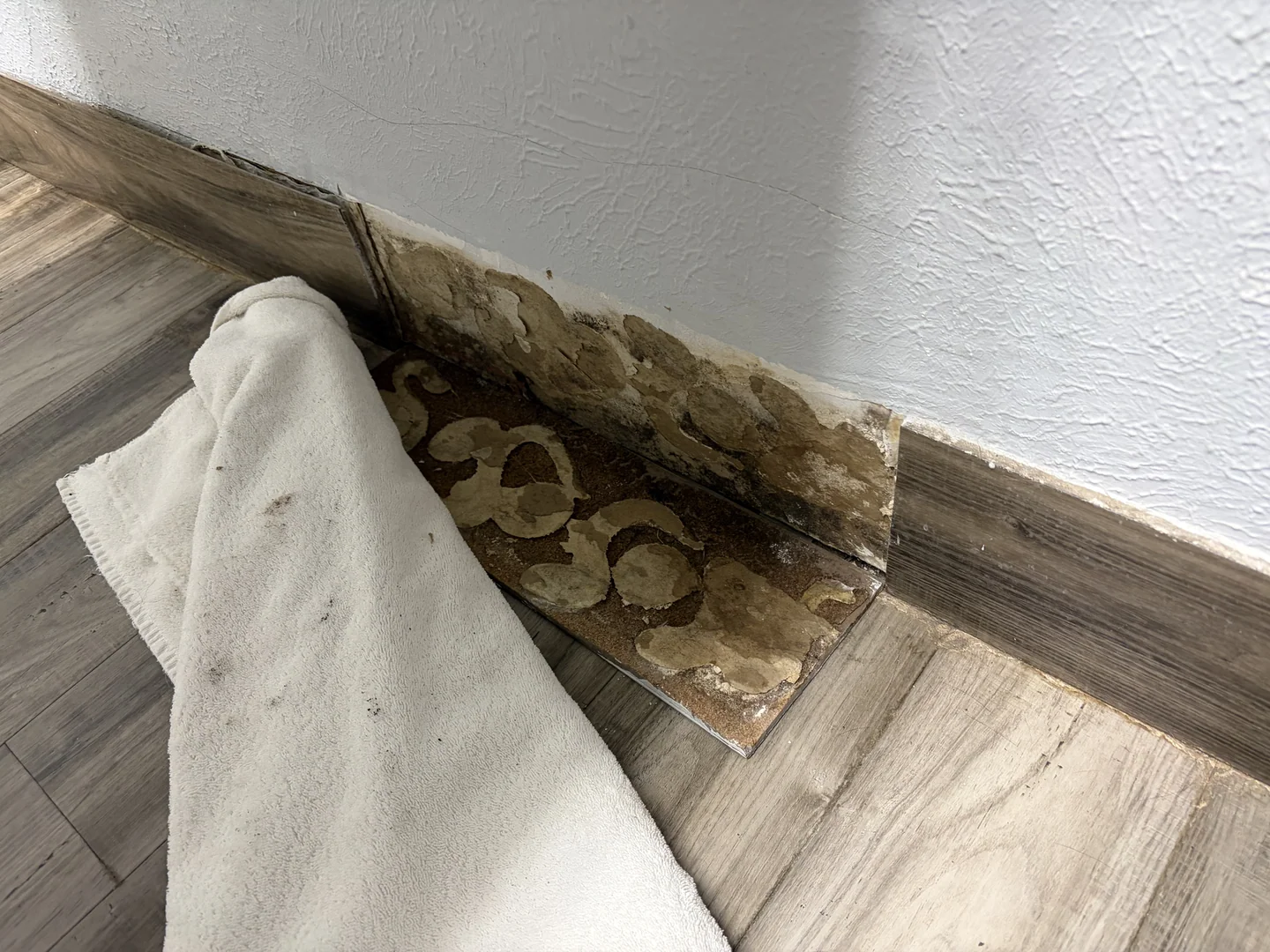
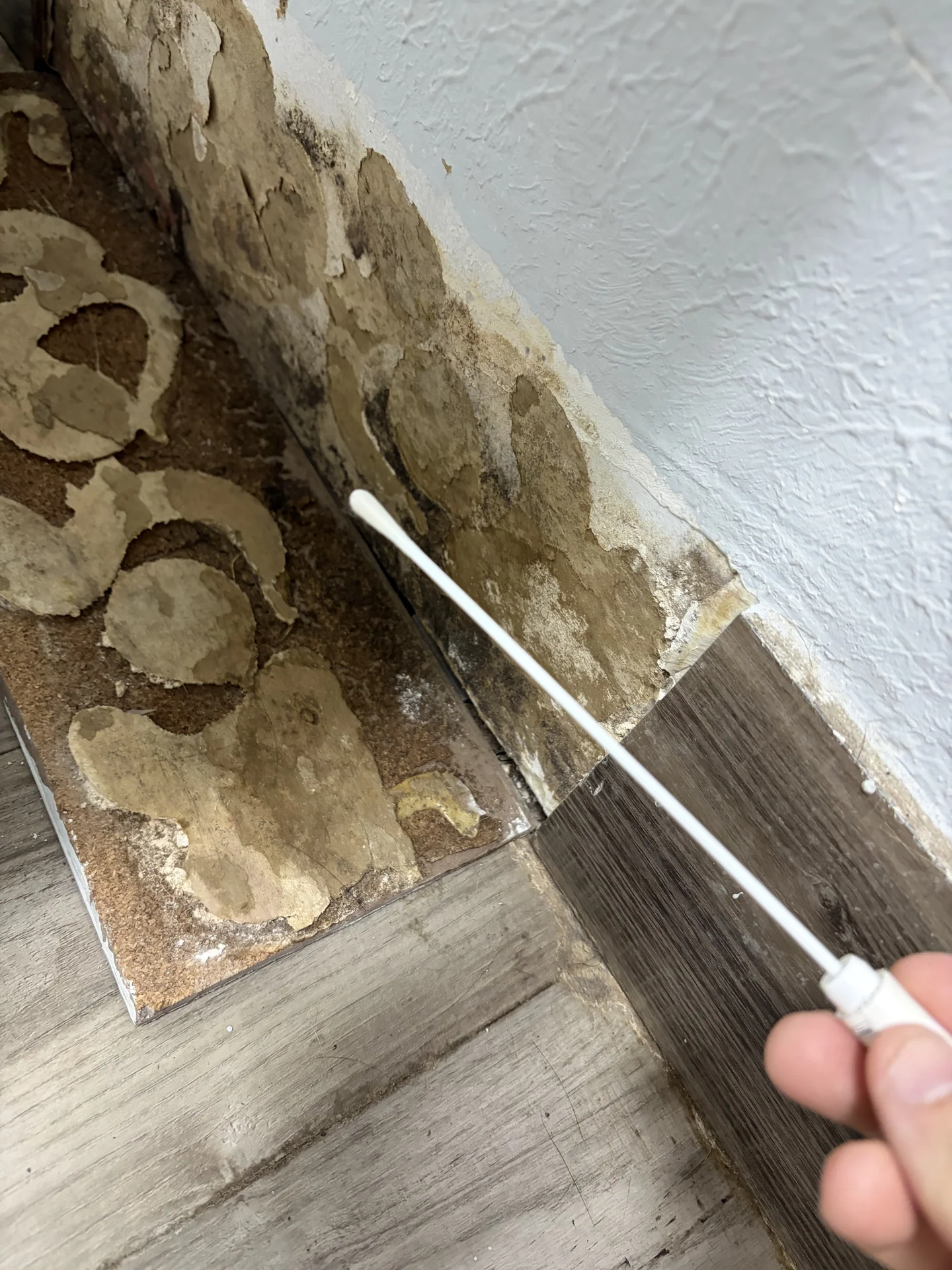
- The surface swab was collected from exposed drywall at the floor-wall joint behind trim that had already detached. The assessor did not remove the trim, remove flooring, open the floor assembly, remove additional drywall, inspect beneath flooring or perform demolition.
- No outdoor reference was collected: the sample characterized an enclosed wall cavity, not occupied-room breathing air. The front bathroom was inspected but not sampled.
What We Observed
No active water was observed, comparative moisture readings were not elevated and no visible mold was observed on accessible surfaces inside the repaired closet.
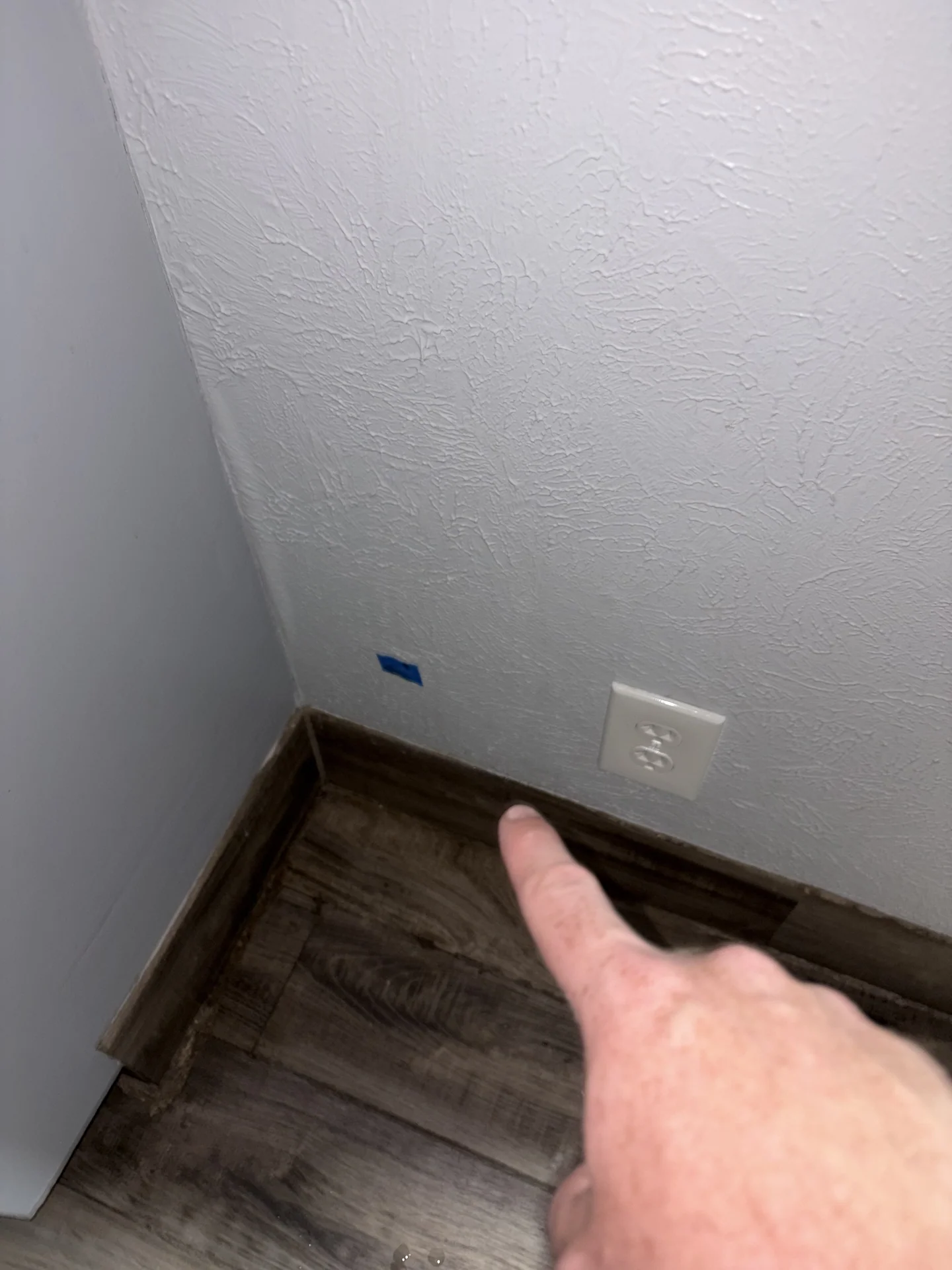
In Exam Room 1, trim that had already detached exposed drywall with dark discoloration, staining and residual trim adhesive at the floor-wall joint. The discoloration appeared consistent with possible fungal growth and was surface-swabbed.
The front bathroom had no observed staining, musty odor, damaged trim, visible mold or current comparative moisture anomaly. It was not sampled, and concealed conditions beneath its flooring were not evaluated.
The Leak Appeared Repaired, and the Area No Longer Read Wet
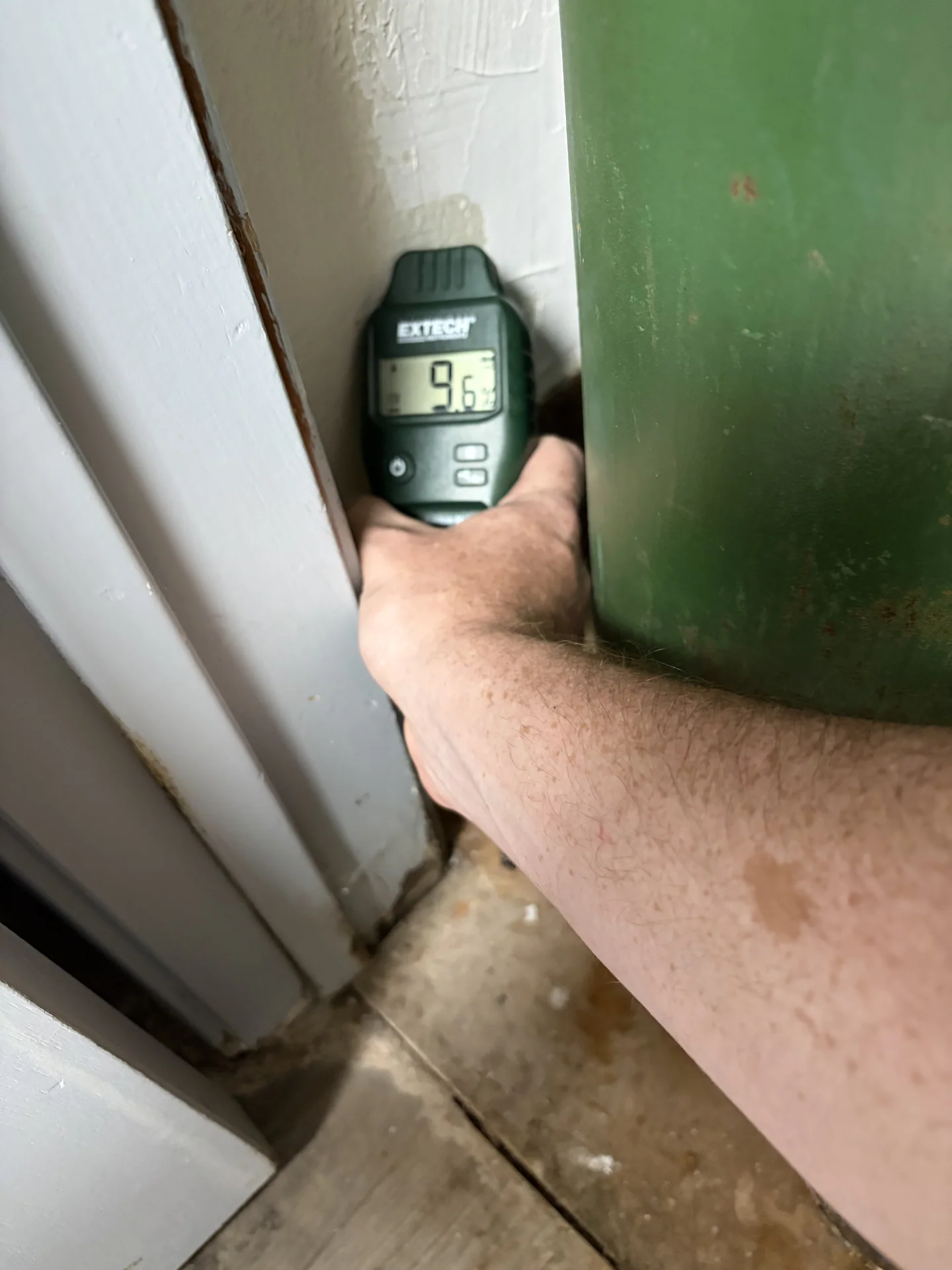
No active water was observed. Comparative Extech pinless readings were approximately 8–12 throughout the repaired closet, Exam Room 1 and front bathroom. The closet-wall reading at the repaired leak location was 9.6, without a significant anomaly relative to surrounding areas.
At inspection, the repair appeared to have stopped the leak, consistent with staff reports that floor water stopped after repair. These were comparative readings of accessible materials, not exact moisture percentages or proof that complete wall and floor assemblies were dry. Floor assemblies were not opened or evaluated with substrate-specific testing.
A Dry Reading Today Does Not Erase a Past Water Event
Fungal growth can develop while building materials are wet. After the source is corrected, active water may no longer be visible and surface readings may return to normal, while growth that developed during the wet period can remain. Here, non-elevated current readings and no active water did not negate laboratory-confirmed growth on previously water-affected drywall.
Mold Was Found Behind Detached Wall Trim in Exam Room 1
The trim had already detached before the assessment; Mold Testing Dallas did not remove it. The exposed drywall at the floor-wall joint showed dark discoloration, staining and residual trim adhesive. A surface swab was collected from the drywall to evaluate the suspected growth.
What Was Found Inside the Shared Wall?
With the owner's prior approval, a small sampling port was drilled through the Exam Room 1 wall shared with the repaired-leak closet. A 7.5-L spore-trap cavity sample was collected, and the port was covered with tape. No flooring or additional drywall was removed, and no demolition was performed.
Moisture / Building Conditions
Extech pinless comparative screening: approximately 8–12 throughout the repaired closet, Exam Room 1 and front bathroom; no reading stood out significantly from surrounding areas.
Repaired closet leak location: 9.6 comparative relative response, not an exact moisture-content percentage.
No active water observed. Accessible-material screening did not establish that the entire wall or floor assembly was completely dry; no substrate-specific floor testing was performed.
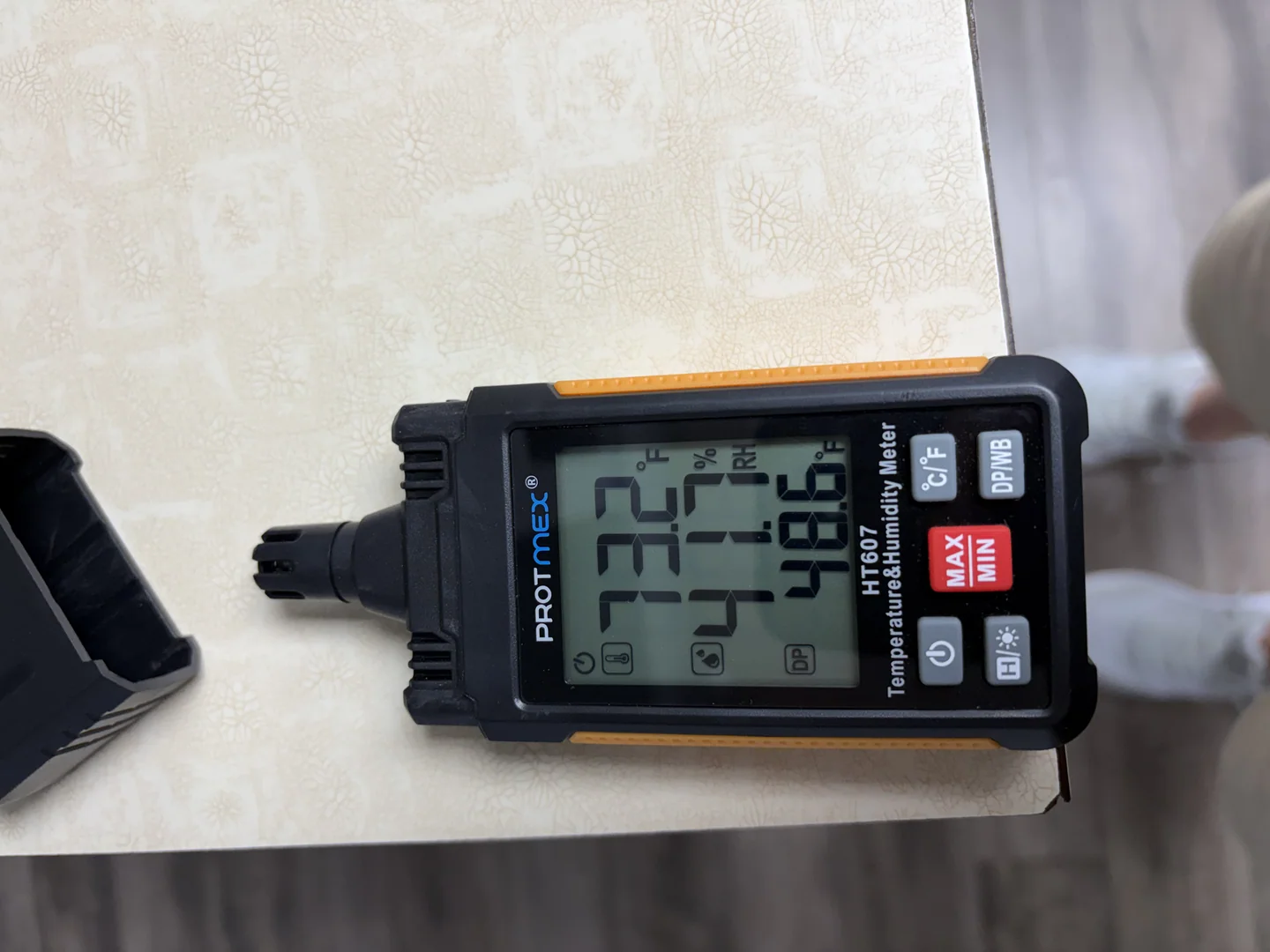
Indoor conditions: 73.2°F, 41.7% RH and 48.6°F dew point. The RH was below 60% at inspection, not evidence of conditions throughout the historical water event.
Sampling Performed
- Surface swab — direct microscopic examination — Exposed drywall at the Exam Room 1 floor-wall joint: Behind trim that detached before inspection.
- 7.5-L spore-trap wall-cavity air sample — Exam Room 1 wall shared with the repaired-leak closet: Owner-approved drilled sampling port; covered with tape afterward. Analytical sensitivity: 430/m³; debris: Light. No outdoor reference or occupant-air sample.
Surface Swab — Exposed Drywall Behind Previously Detached Trim
| Finding | Reported result | Context |
|---|---|---|
| Chaetomium | Heavy | |
| Aspergillus/Penicillium-like | Heavy | |
| Hyphal fragments | Heavy | |
| Basidiospores | Moderate | |
| Stachybotrys | Minor | |
| Non-specified spore | Minor | |
| Myxomycetes/Periconia/Smut/Rust | Minor |
Shared Wall-Cavity Results — 7.5-L Spore-Trap Sample, Not Occupant Air
| Finding | Reported result | Context |
|---|---|---|
| Total fungal | 14,000 structures/m³ | Reported total; not an exposure measurement or a stand-alone determination of concealed growth. |
| Aspergillus/Penicillium-like | 7,300 /m³ | 17 raw structures |
| Chaetomium | 1,300 /m³ | 3 raw structures |
| Cladosporium | 1,300 /m³ | 3 raw structures |
| Pithomyces | 860 /m³ | 2 raw structures |
| Basidiospores | 430 /m³ | 1 raw structure |
| Non-specified spore | 430 /m³ | 1 raw structure |
| Hyphal fragments | 2,200 /m³ | 5 raw structures |
| Debris | Light | |
| Analytical sensitivity | 430 /m³ |
What the Surface Results Confirmed
The laboratory defines Heavy as more than three fungal structures per microscope field of view. Heavy Chaetomium, Heavy Aspergillus/Penicillium-like, Heavy hyphal fragments and visible staining were interpreted as consistent with fungal growth on the sampled drywall rather than ordinary settled fungal material alone.
Minor Stachybotrys was detected on the sampled drywall, while the dominant findings were Heavy Chaetomium, Heavy Aspergillus/Penicillium-like and Heavy hyphal fragments. This is not a species-level identification or a health-risk conclusion.
Why the Chaetomium Mattered More Than the Total Mold Number
A cavity sample characterizes fungal structures inside an enclosed wall; it is not a measure of what occupants are breathing. No outdoor reference was collected because outdoor air is not necessarily an appropriate baseline for a closed wall cavity.
Aspergillus/Penicillium-like spores can occur in wall cavities without a documented water-loss history. Neither 7,300/m³ Aspergillus/Penicillium-like nor the 14,000/m³ total proves hidden growth by itself.
The more informative findings were Chaetomium at 1,300/m³ and hyphal fragments at 2,200/m³. Chaetomium is water-associated and not typical of a dry cavity. Together with the leak history, Heavy Chaetomium on the sampled drywall and floor-wall staining, these findings supported concern for possible growth within the concealed assembly.
What the Findings Suggested
Fungal growth was confirmed on the sampled exposed drywall despite non-elevated current comparative moisture readings and no active water.
Cavity findings supported possible concealed growth in the shared wall but did not establish its extent, occupant exposure, conditions throughout the building or mold beneath flooring.
The Front Bathroom Had a Water History but No Visible Mold at Inspection
Staff identified the front bathroom as another area with historical floor saturation. At inspection there was no visible mold, staining, musty odor, damaged trim or significant comparative moisture anomaly; readings were approximately 8–12. The bathroom was not sampled. No visible mold or current moisture anomaly was identified on accessible surfaces, but concealed conditions beneath the floor were not evaluated.
Staff Reported Water at the Floor for Approximately Two Years
Staff described periodically saturated-feeling flooring and small amounts of water appearing at the floor surface in Exam Room 1 and the front bathroom over approximately two years. They reported that the condition stopped after the plumbing repair.
That history suggests repeated or prolonged wetting may have affected the floor assemblies. The timing reported by staff was consistent with the repaired leak being associated with the floor-water condition, but the historical condition, source and pathway were not independently verified. The assessment did not attribute every historical event to the repaired leak.
Professional Mold Remediation Was Recommended
Professional mold remediation was considered warranted, using an appropriately licensed Texas mold-remediation contractor. Mold Testing Dallas performed this assessment under a Mold Assessment Technician license. A licensed Mold Assessment Consultant must prepare the formal remediation scope/protocol where required; this case study does not supply demolition dimensions, containment design, engineering controls or clearance criteria.
Why Independent Assessment Was Requested
The owner's plumber reportedly repaired the leak and stated that no mold was present. Tenant representatives requested independent testing, and the building owner retained Mold Testing Dallas. Independent documentation addressed the post-water-loss concern without assigning fault to the plumber, tenant or owner.
Recommendations
- Perform professional mold remediation using an appropriately licensed Texas mold-remediation contractor.
- Have a licensed Mold Assessment Consultant determine the formal remediation scope/protocol where required.
- Further investigate areas affected by the reported historical water intrusion: Exam Room 1, the shared closet wall, front bathroom and other areas where water was historically observed.
- Have appropriate professionals evaluate concealed surfaces beneath trim, flooring and lower wall materials as warranted.
- Confirm floor moisture using material-appropriate testing rather than pinless comparative readings alone.
- For concrete slab conditions, an appropriate professional may consider substrate-specific methods such as in-situ relative-humidity testing.
- Avoid unnecessary disturbance of the exposed mold-affected area behind the detached trim.
- If suspected growth is exposed elsewhere, stop uncontained cleaning or demolition and obtain professional guidance.
- Conduct independent post-remediation assessment and clearance when required by Texas regulations.
- Determine applicable asbestos, lead-based paint and other hazardous-material requirements before disturbing flooring, adhesive, baseboard or painted materials.
- Maintain indoor RH below 60%. Indoor RH at inspection was 41.7%.
What Homeowners Can Learn From This Case
Repairing a leak is only one part of addressing water damage. Fungal growth developed during prior wetting can remain even when the plumbing source appears repaired, no active water is present and comparative readings are not elevated.
Commercial water-loss evaluation may include reported history, adjacent areas, lower walls and baseboards, comparative moisture screening, targeted surface sampling and cavity sampling where appropriate.
Historically wet flooring and concealed assemblies may warrant further investigation. Neither normal surface readings nor one cavity sample establishes conditions throughout those assemblies.
Questions About This Case
Can mold remain after a plumbing leak has been repaired?
Yes. Once the leak is corrected, materials may dry and current moisture readings may return to normal even though fungal growth that developed during the wet period remains. In this case, the leak appeared repaired and current moisture readings were not elevated, yet fungal growth was confirmed on previously water-affected drywall.
Can mold be behind baseboard or wall trim after a leak?
Yes. Lower wall areas can conceal water damage behind trim. In this case, a section of trim had detached and exposed stained drywall that tested Heavy for Chaetomium, Aspergillus/Penicillium-like structures and hyphal fragments.
What mold was found in this commercial building?
The exposed drywall sample returned Heavy Chaetomium, Heavy Aspergillus/Penicillium-like structures and Heavy hyphal fragments, along with Moderate basidiospores and Minor Stachybotrys and other fungal structures.
Was mold found inside the wall?
The wall-cavity air sample contained Chaetomium and hyphal fragments along with other fungal structures. Combined with the known leak history and surface findings, the report concluded that fungal growth may also be present inside the concealed wall assembly, but its extent was not determined.
Why was there no outdoor air sample?
The air sample was collected inside a closed wall cavity, not in occupied-room air. Outdoor air is not necessarily an appropriate comparison for an enclosed cavity, so the result was interpreted using the cavity history, fungal types and physical findings instead.
Does 14,000 mold structures per cubic meter automatically prove a mold problem in a wall?
No. Wall-cavity concentrations need context. Aspergillus/Penicillium-like spores can occur in dry cavities. In this case, the more significant findings were the presence of water-associated Chaetomium and hyphal fragments in a wall with a documented leak history.
Can the floor still have hidden water damage if the moisture meter reads normally?
Yes. Surface comparative moisture screening does not establish the condition beneath flooring or within the slab. In this case, the floor assemblies were not opened, so concealed water damage or fungal growth could not be ruled out.
Was mold found in the front bathroom?
No visible mold was observed on accessible front-bathroom surfaces and the area was not sampled. Concealed conditions beneath the flooring were not evaluated.
Related Services
Had a Plumbing Leak at a Commercial Property?
Even after a leak is repaired and surfaces appear dry, previously wet drywall, flooring and concealed wall materials may still warrant evaluation. Mold Testing Dallas provides independent commercial mold assessments throughout Dallas-Fort Worth.
Schedule a Commercial Mold InspectionInspection performed by Ethan Wright, TDLR Licensed Mold Assessment Technician (MAT #1589).
Related Real Inspection Cases
Compare a residential plumbing-leak case with fungal growth inside an exposed shared wall, a hidden-wall investigation, a bathroom sink-cabinet case and dishwasher-leak kitchen-island case. The leaking mini-split case offers a separate commercial water-source comparison. Here, the leak had already been repaired and current comparative readings were non-elevated, but growth remained behind detached trim and the cavity findings supported concern about concealed growth.
Mold Found Below a Leaking Mini-Split
A commercial client in Waco, Texas requested a limited mold assessment after an employee raised concern about possible mold in a work area. The assessment focused on two rooms. In the Front Room, a wall-mounted mini-split was actively dripping, with evidence of water traveling down the wall to the floor line. Surface testing confirmed fungal growth behind the flexible cove base below the mini-split. Air samples from both rooms were below the outdoor reference and did not indicate airborne fungal amplification at the sampled locations and time.
View Case Study →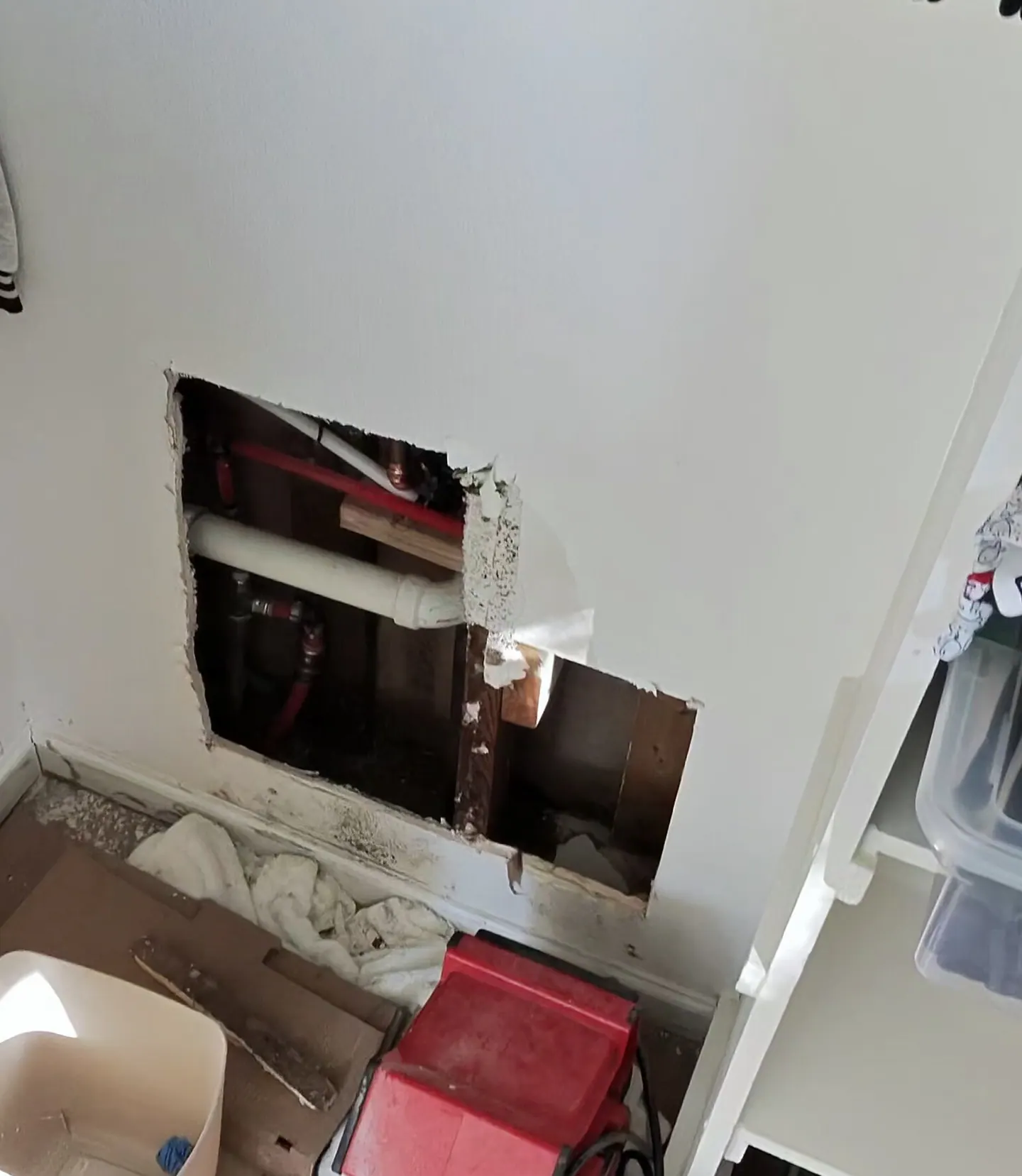
Mold Found Inside a Wall After a Plumbing Leak in Farmers Branch
A Farmers Branch homeowner requested a limited mold assessment after a reported plumbing leak affected a wall shared by a guest bathroom and two closets. The leak had reportedly been repaired, but existing repair openings exposed stained wallboard and framing. A swab through the guest bedroom closet opening supported fungal growth on sampled material. Separate ceiling and former exterior-wall concerns had different, more limited findings.
View Case Study →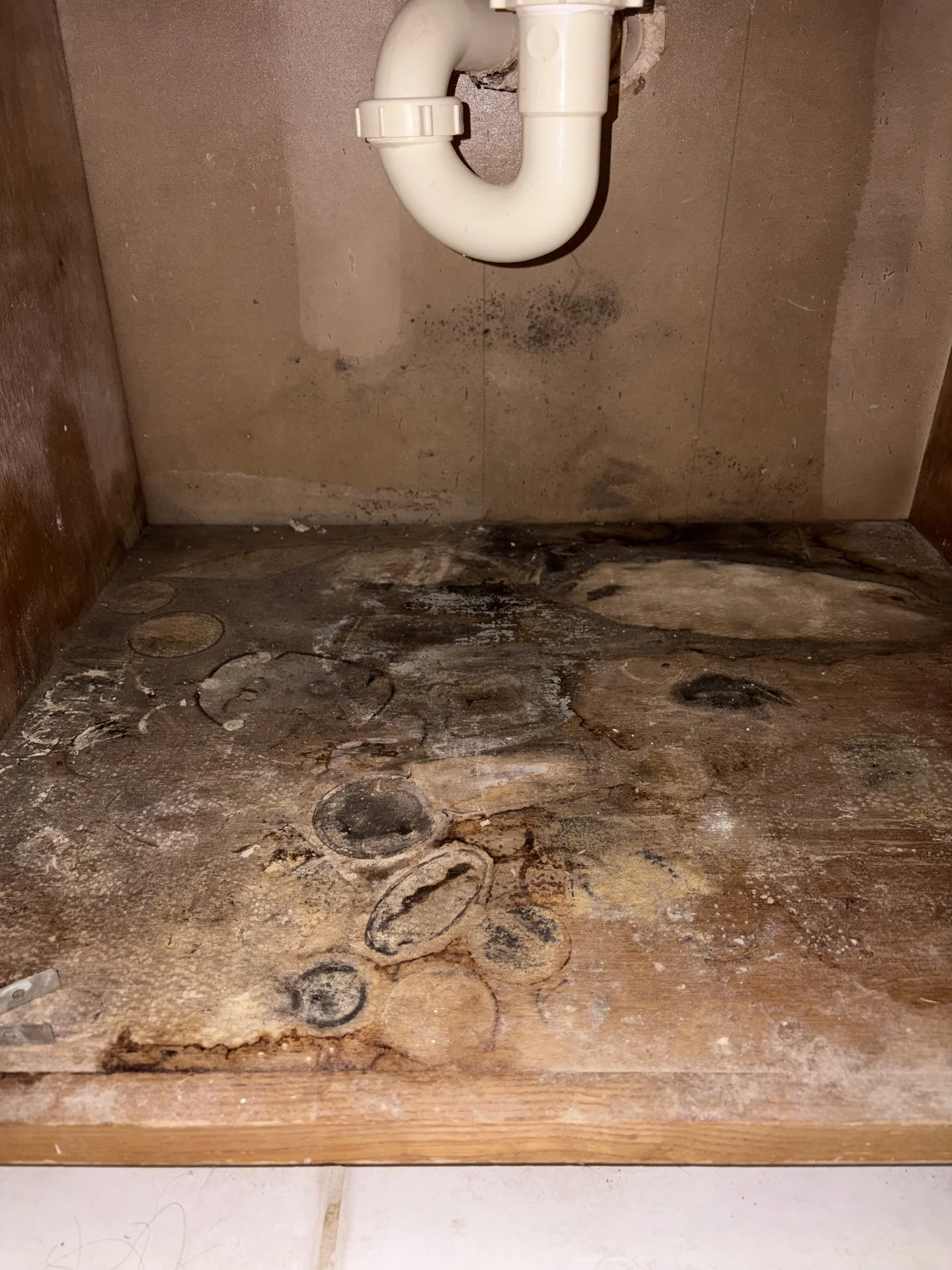
Hidden Mold Found Under a Bathroom Sink Cabinet
A homeowner reported a bathroom sink leak that occurred only during sink use. Although the sink had reportedly not been used for several days, the cabinet floor, toe kick and base were still visibly wet. The floor showed staining, swelling, delamination and suspected mold-like discoloration. A cabinet-floor swab returned Heavy Chaetomium and Heavy hyphal fragments. Through a small drilled access hole, limited borescope viewing showed suspected growth beneath the cabinet floor, and a 10-liter cavity air sample contained more than 76,000 Aspergillus/Penicillium-like spores/m³ and more than 80,000 total fungal structures/m³. Remediation of the affected cabinet and related materials appeared warranted; the specific plumbing failure and concealed extent remained undetermined.
View Case Study →Hidden Mold Found Inside Wall Cavities in a Dallas Home
A Dallas homeowner requested a limited assessment after concerns about possible concealed mold and prior water-damage conditions. Occupied-room air samples were below the outdoor reference, while two concealed wall cavities had substantially different findings. One cavity showed moisture abnormalities, deteriorated finishes and apparent growth by borescope; a second cavity returned more than 55,000 total fungal structures per cubic meter when re-sampled after its first sample was occluded. An upstairs storage area also showed moisture and apparent growth.
View Case Study →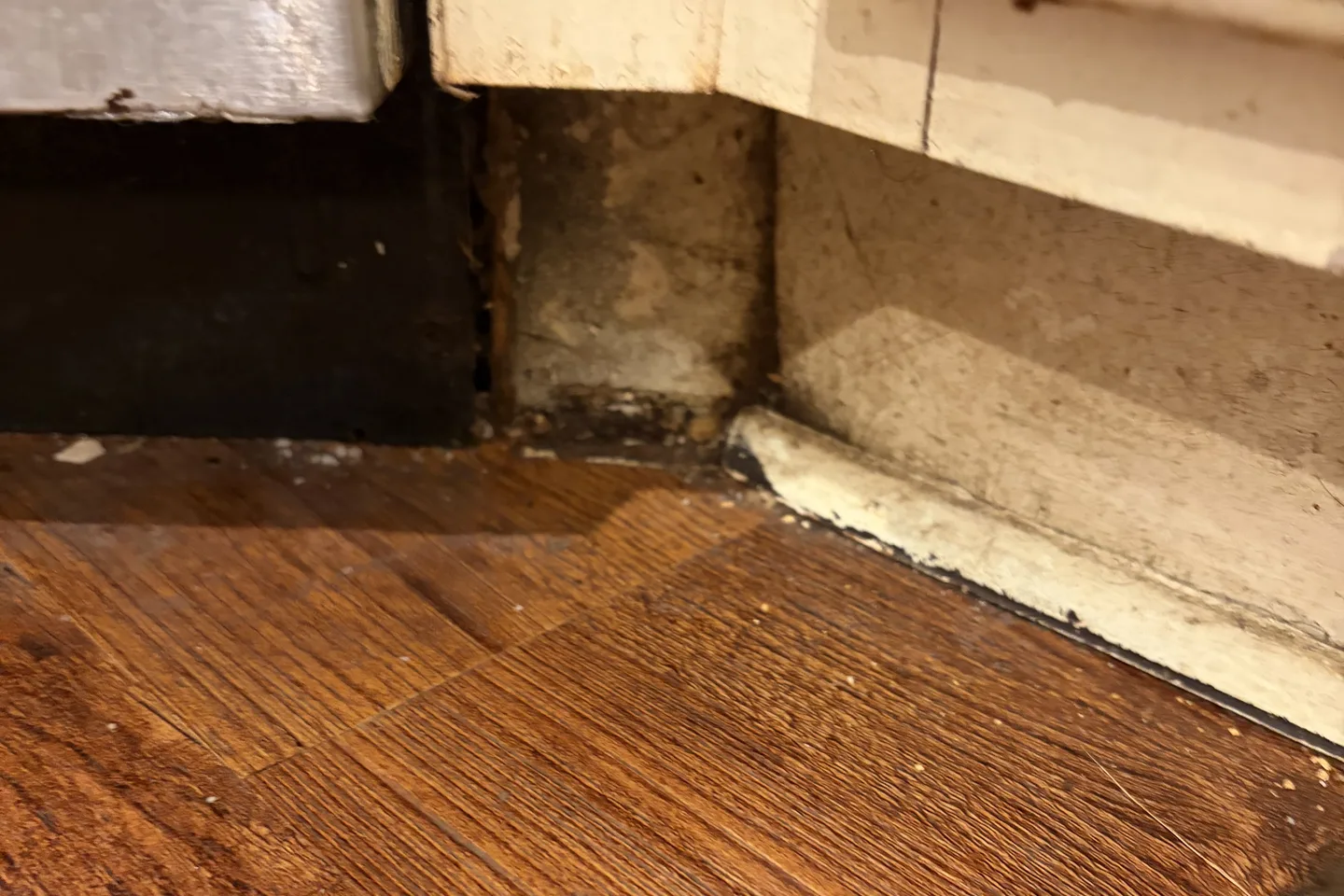
Mold Found Behind a Kitchen Toe-Kick From a Dishwasher Leak
A Frisco homeowner requested a limited mold assessment because of a musty odor near the kitchen sink. No visible mold growth was observed on accessible surfaces inside the stained sink base cabinet. Immediately to the left of the sink, beside the dishwasher, a detached and deteriorated toe-kick was very wet and visibly discolored. An active dishwasher leak was observed, and a surface swab confirmed fungal growth on the toe-kick, including Heavy Aspergillus/Penicillium-like structures and Moderate Cladosporium. Concealed areas behind and beneath the dishwasher, beneath cabinetry and at the subfloor were not opened or evaluated.
View Case Study →