
- Location
- McKinney, Texas
- Property type
- Residential — tenant-occupied
- Inspection type
- Limited mold assessment
- Primary concern
- Wet, discolored kitchen-island cabinetry after a reported dishwasher supply-line leak and prior cleaning
- Inspection
- October 2026
The Situation
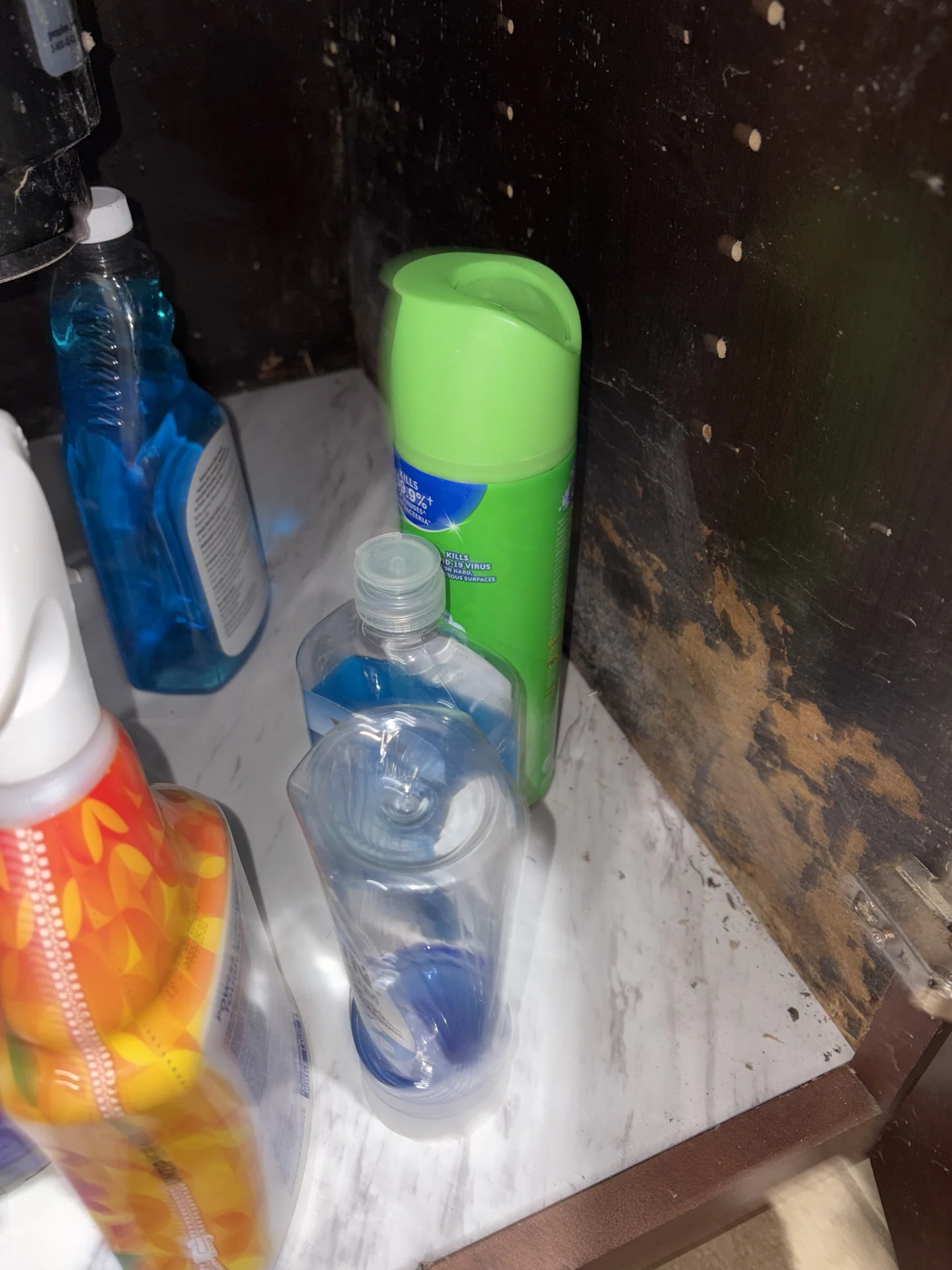
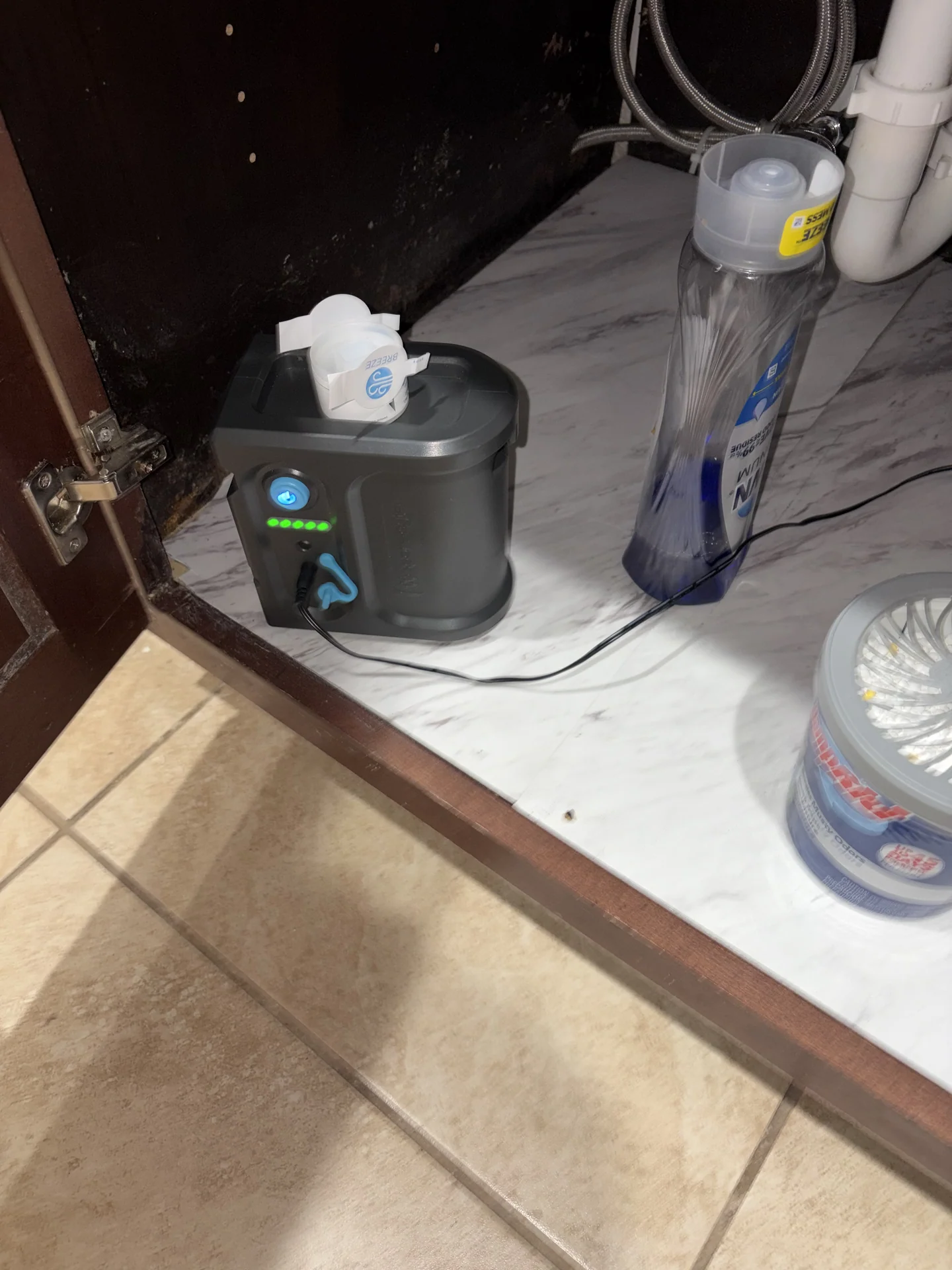
The tenant reported a dishwasher supply-line leak inside the kitchen island at the sink location, followed by visible mold beneath the sink, in the sink-base cabinet and in the pull-out drawer area immediately to its right.
The tenant said that cleaning had already been performed by others and requested a formal mold assessment and testing. The reported leak and cleaning history were client-provided information.
The assessment was limited to the kitchen island, sink-base cabinet, adjacent pull-out drawer bay and lower cabinet face / toe kick. No other areas of the home were included.
What Was Inspected
- Visual inspection of accessible cabinet surfaces, moisture-meter screening, one surface swab, one cabinet-area spore-trap sample, one outdoor reference spore-trap sample and indoor temperature and relative humidity measurement.
- Cabinet doors were opened and the adjacent drawer was pulled out for visual access. The assessor did not remove cabinetry, cabinet panels or flooring, open wall cavities or the cabinet floor, inspect beneath the liner or inspect beneath the island.
- The surface swab came from visible dark discoloration at the bottom of the sink-base cabinet rear interior panel. The drawer bay was not separately swabbed.
- The indoor 75-L air sample was collected inside the open sink-base cabinet, not in general occupied-room air.
What We Observed
With sink-base cabinet doors open, accessible surfaces showed dark discoloration, mottling and finish deterioration, most pronounced along the bottom of the rear interior panel and right interior side panel.
The floor had a marble-pattern liner. Materials beneath that liner and the underside of the cabinet floor were not accessible.
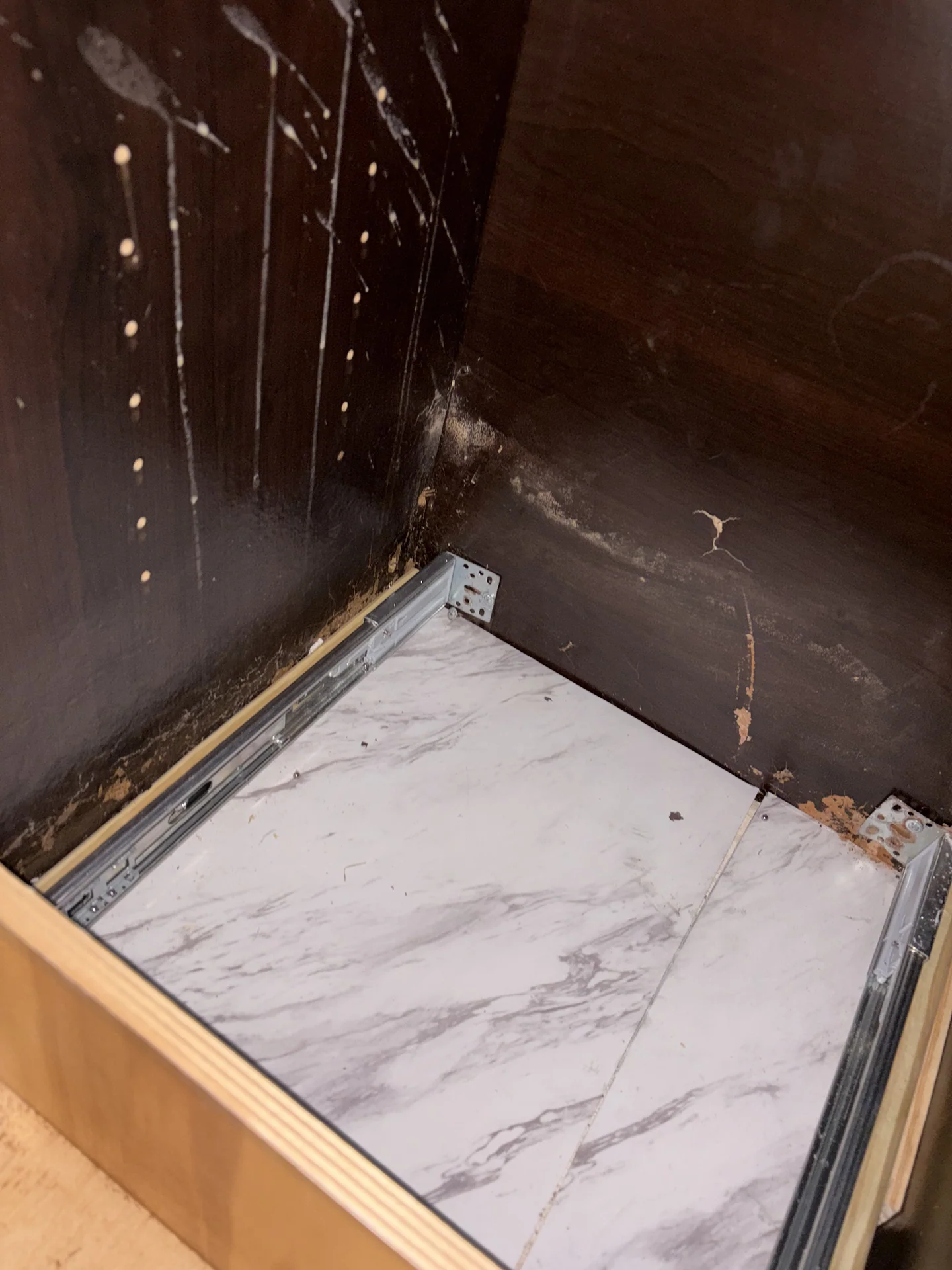
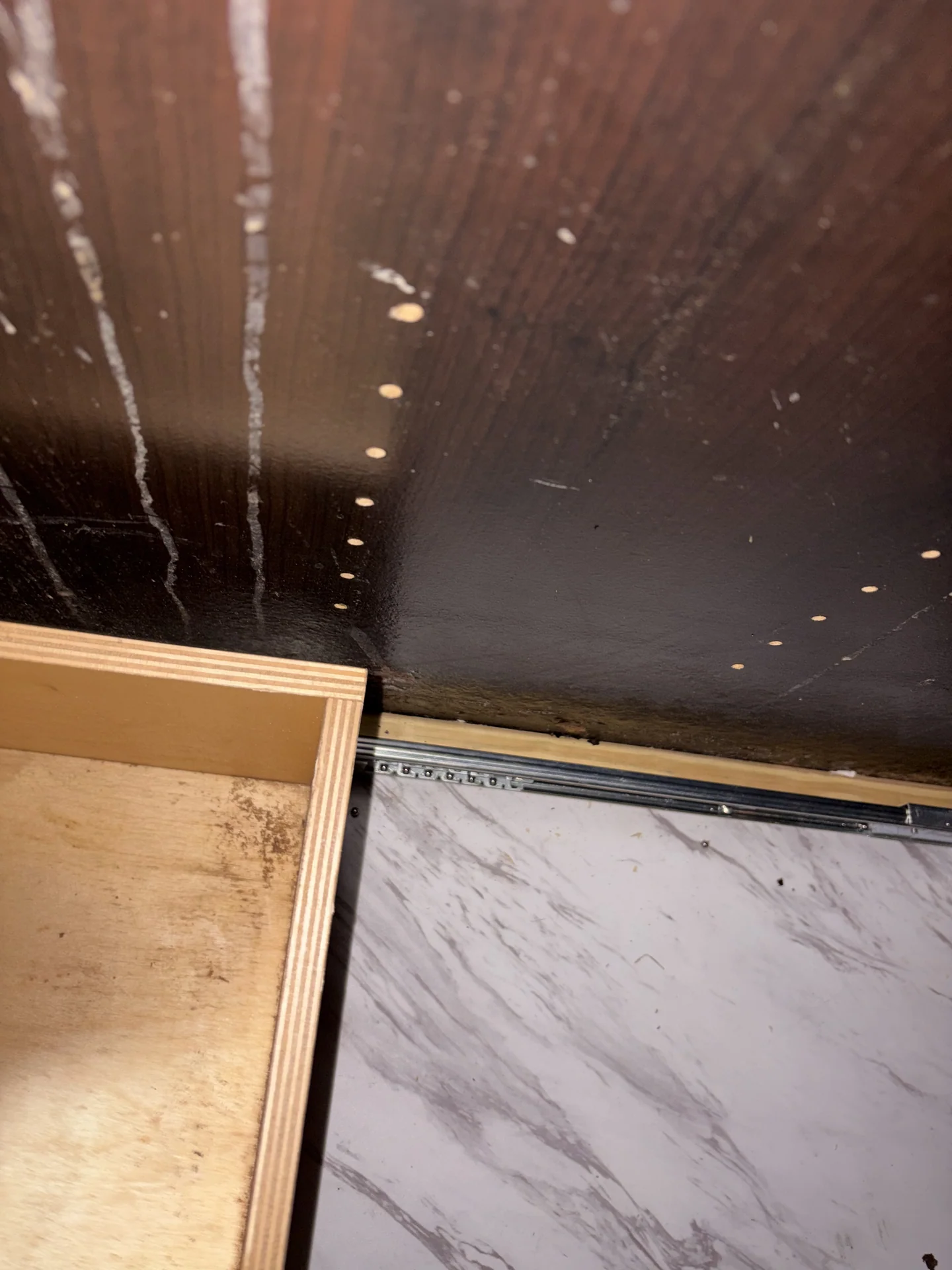
The drawer immediately to the right of the sink was pulled out for inspection. Its bay had dark discoloration, vertical streaking and lower rear-corner finish deterioration in the area where the tenant reported previous visible mold.
Visible Discoloration Remained After the Area Had Been Cleaned
Visible discoloration remained after the cleaning reported by the client. Accessible cabinet surfaces showed dark discoloration, mottling and finish deterioration, most pronounced at the bottom of the rear interior panel and right interior side panel.
The assessment did not evaluate or assign fault to the prior cleaning work. The marble-pattern liner and cabinet floor were not opened; materials below the liner and the cabinet-floor underside were inaccessible.
Adjacent Cabinetry Also Showed Water-Damage Indicators
Pulling out the adjacent drawer provided visual access to dark discoloration, vertical streaking and finish deterioration at the lower rear corner of the drawer-bay panel. The tenant reported earlier visible mold there. This area was not separately laboratory confirmed; the surface swab came from the sink-base cabinet rear panel.
The Cabinet Materials Were Still Wet
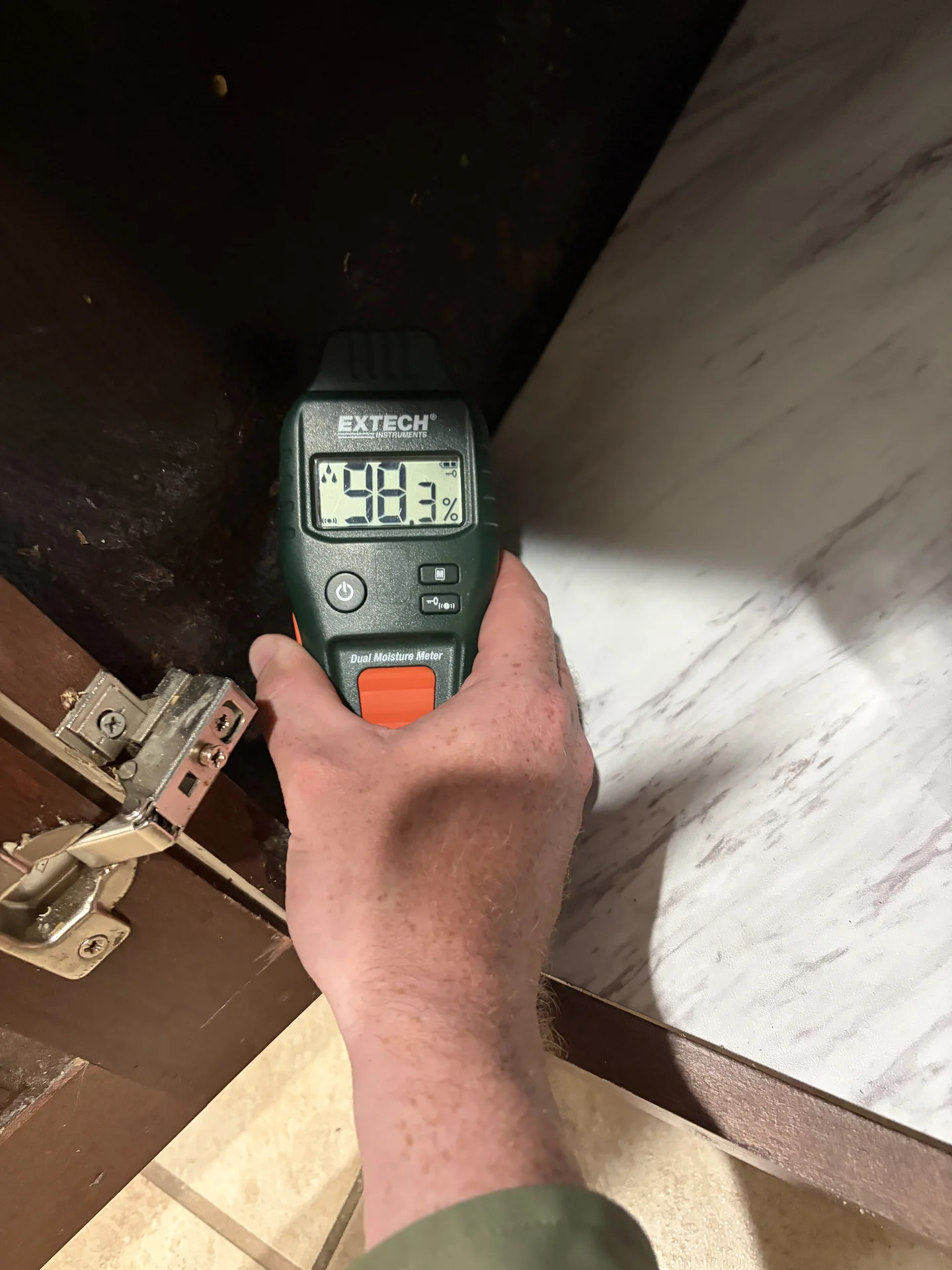
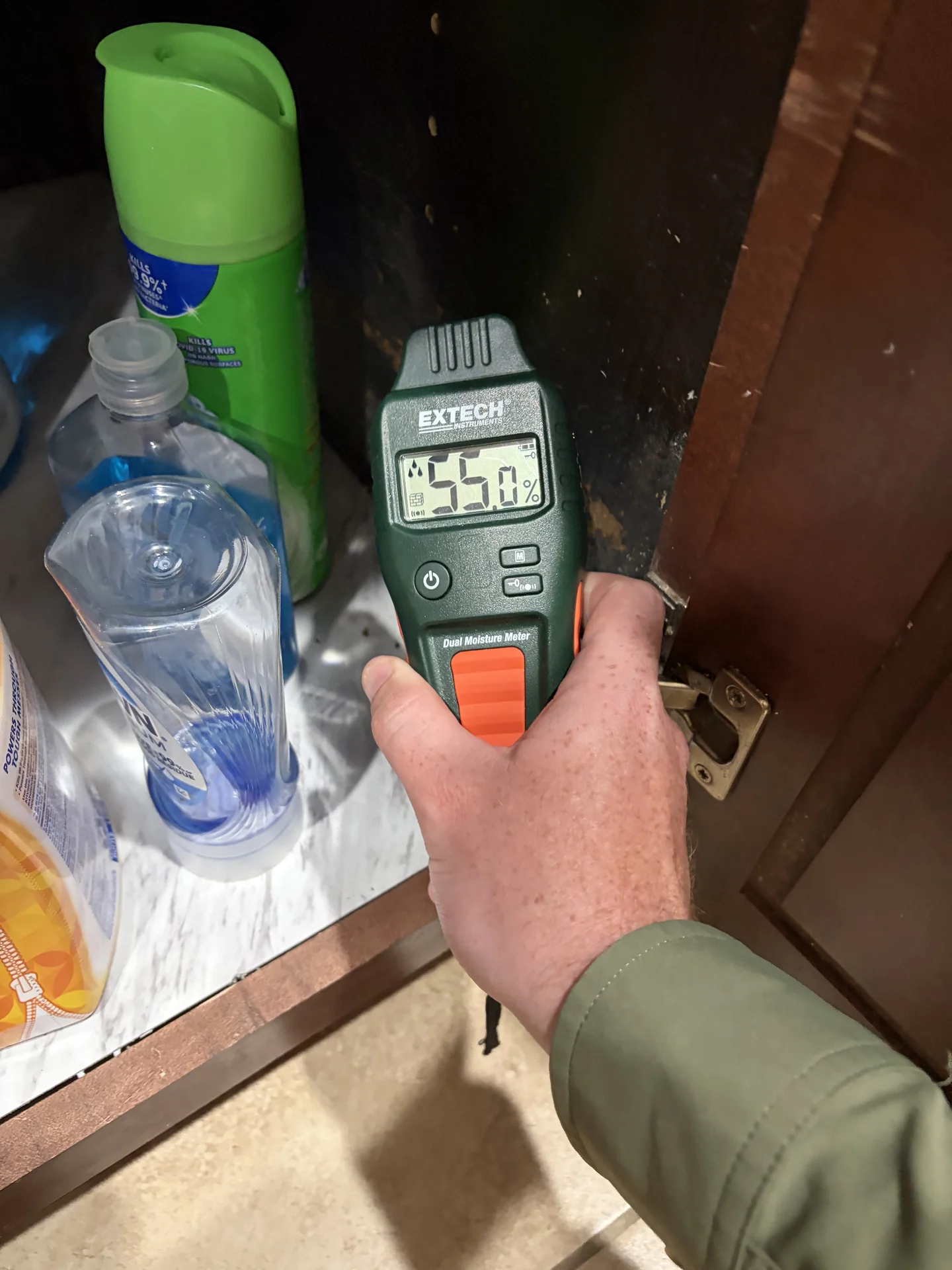
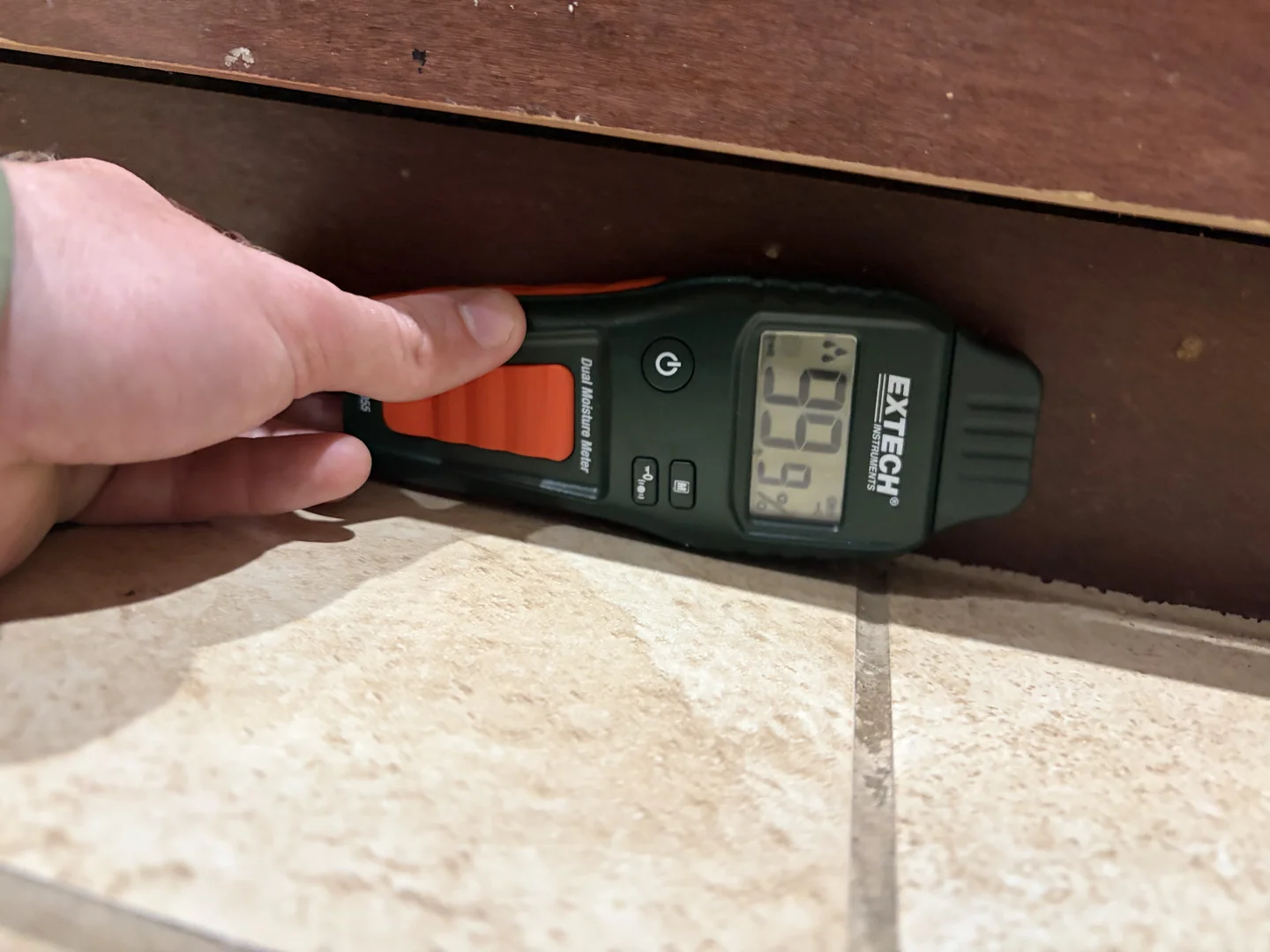
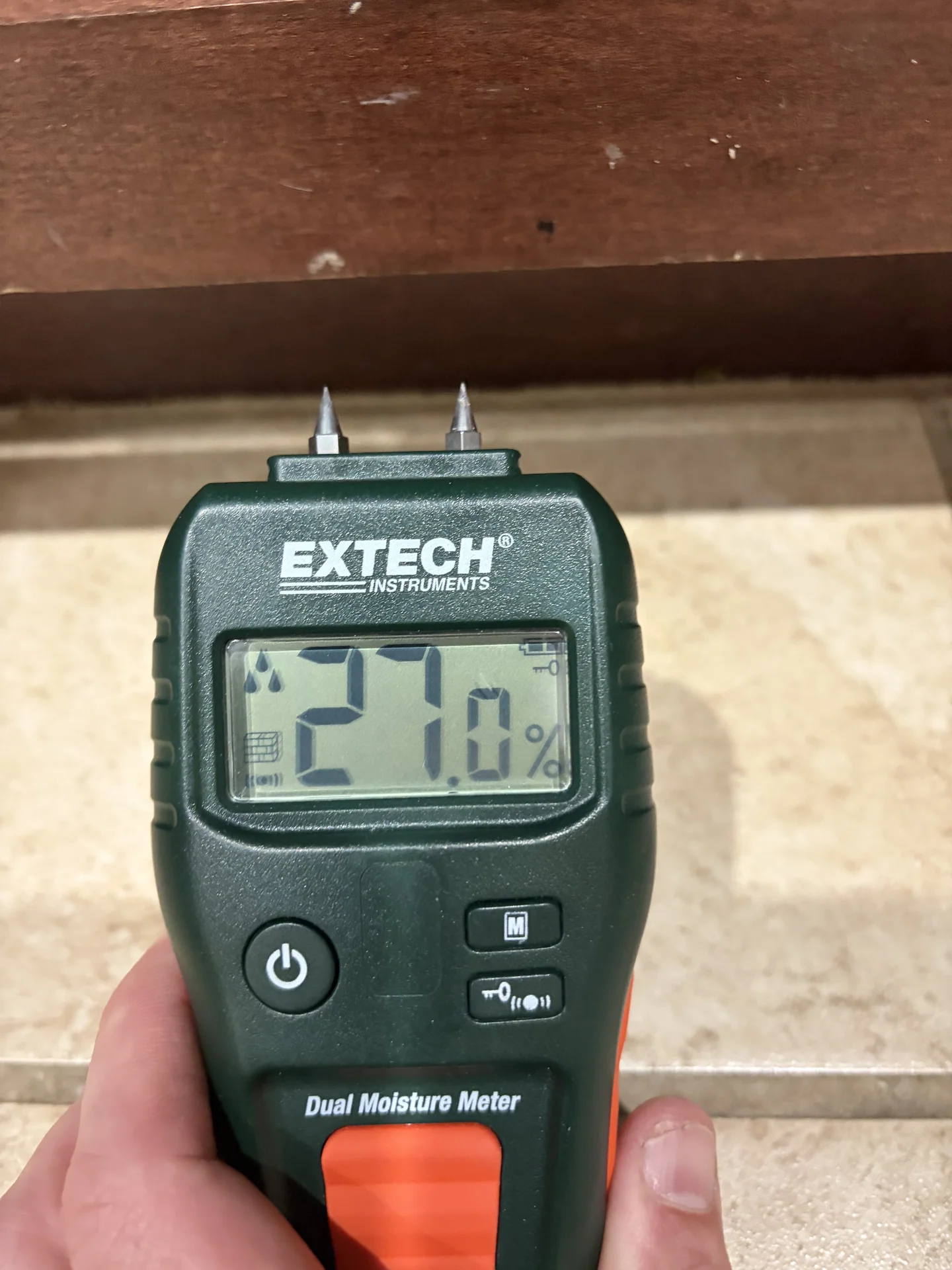
The report interpreted the elevated moisture responses as indicating that cabinet materials remained wet. The moisture condition associated with the reported leak had not fully resolved, and persistent moisture can support continuing fungal growth. This did not establish that the supply line was still actively leaking; verification of complete repair was recommended.
Moisture / Building Conditions
Left interior cabinet panel: 98.3 comparative pinless response.
Right interior cabinet panel: 55.0 comparative pinless response.
Lower cabinet face / toe-kick area: 99.9 comparative pinless response.
Toe kick: 27.0% on the meter’s wood scale, an approximate pin reading rather than exact moisture content of engineered cabinetry.
No unaffected reference area of comparable material was documented. Pinless responses indicate relative wetness, not exact moisture content.
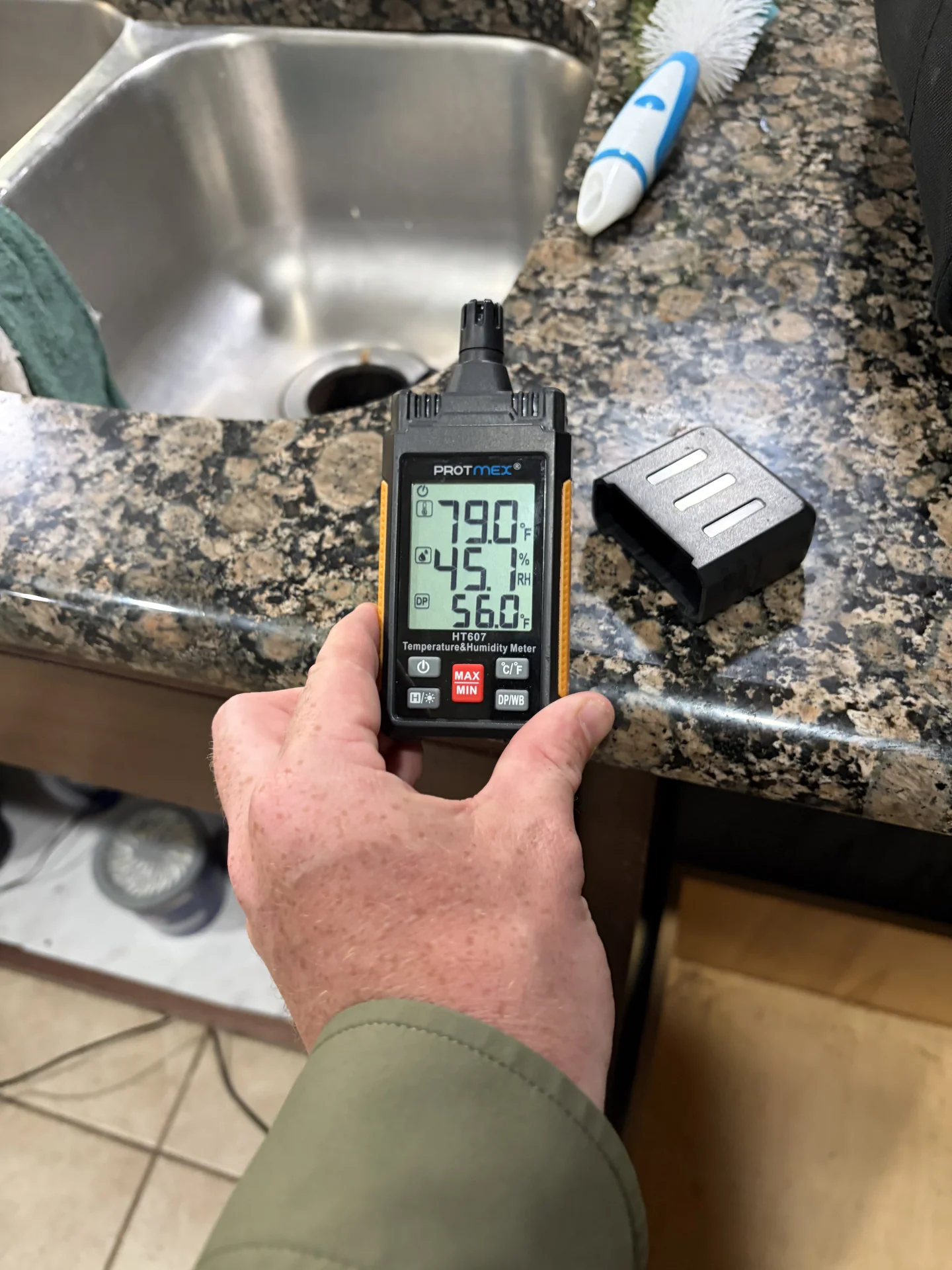
Indoor conditions: 79.0°F, 45.1% RH and 56.0°F dew point. The cabinet materials remained wet despite indoor RH being below 60%.
Sampling Performed
- Surface swab — direct examination — Sink-base cabinet, bottom of rear interior panel: Visible dark discoloration; adjacent drawer bay not separately sampled.
- 75-L spore-trap air sample — Inside the open sink-base cabinet: Cabinet-area sample, not general room air. Light debris; laboratory stopping rule reached.
- Outdoor reference spore-trap air sample — Outdoors: Comparison of fungal concentration and composition with cabinet-area air.
Surface Swab — Bottom of Sink-Base Cabinet Rear Interior Panel
| Finding | Reported result | Context |
|---|---|---|
| Chaetomium | Moderate | |
| Aspergillus/Penicillium-like | Moderate | |
| Scopulariopsis | Minor | |
| Nigrospora | Minor | |
| Curvularia | Minor | |
| Alternaria | Minor | |
| Ascospores, non-specified | Minor | |
| Cladosporium | Minor | |
| Hyphal fragments | Minor |
Cabinet-Area Air Sample — Inside Open Sink-Base Cabinet, 75 L
| Finding | Reported result | Context |
|---|---|---|
| Aspergillus/Penicillium-like | >4,700 spores/m³ | Approximately 93% of sample; stopping rule reached |
| Total fungal | >5,000 structures/m³ | Stopping rule reached; actual concentration may have been higher |
| Basidiospores | 130 /m³ | |
| Cladosporium | 85 /m³ | |
| Myxomycetes/Periconia/Smut/Rust | 43 /m³ | |
| Hyphal fragments | 43 /m³ | |
| Stachybotrys; Chaetomium | Not detected | |
| Debris | Light |
Cabinet-Area Air Versus Outdoor Reference — Fungal Profiles
| Sample | Finding | Reported result | Context |
|---|---|---|---|
| Cabinet-area air | Aspergillus/Penicillium-like | >4,700 spores/m³ | Approximately 93%; at least about seven times outdoor concentration |
| Outdoor reference | Aspergillus/Penicillium-like | 680 /m³ | Approximately 13% |
| Cabinet-area air | Total fungal | >5,000 structures/m³ | Lower bound; stopping rule reached |
| Outdoor reference | Total fungal | 5,100 structures/m³ | |
| Outdoor reference | Cladosporium | 2,500 /m³ | A more typical outdoor-dominated fungal profile |
What the Moderate Surface Results Mean
Under the laboratory rating system, Moderate means more than 1 and up to 3 fungal structures per microscope field of view. Moderate Chaetomium was particularly relevant because it is associated with persistently wet cellulose-containing materials. The swab also returned Moderate Aspergillus/Penicillium-like and the listed Minor findings; these are not medical or health-risk conclusions.
The Air Inside the Cabinet Was Dominated by Aspergillus/Penicillium-Like Spores
The 75-L sample collected inside the open sink-base cabinet contained >4,700 Aspergillus/Penicillium-like spores/m³ and >5,000 total fungal structures/m³. Aspergillus/Penicillium-like represented approximately 93% of the sample. Basidiospores, Cladosporium, Myxomycetes/Periconia/Smut/Rust and hyphal fragments were also detected; debris was Light.
The laboratory stopping rule was reached. The greater-than qualifiers are essential: neither >4,700 nor >5,000 is an exact concentration, and the actual concentrations may have been higher.
The Total Mold Numbers Looked Similar — The Fungal Makeup Did Not
Similar total fungal concentrations can still represent very different fungal profiles. Reported cabinet-area total fungal was >5,000/m³, versus 5,100/m³ outdoors. These reported numbers were numerically similar; the lower-bound cabinet result does not establish exact equality or which actual total was higher.
Cabinet-area Aspergillus/Penicillium-like was >4,700/m³, approximately 93% of the sample, versus 680/m³ and approximately 13% outdoors—at least about seven times the outdoor concentration. Outdoors, Cladosporium was 2,500/m³ and the profile was more typical of outdoor fungi. Typical outdoor categories such as Cladosporium and ascospores were far less prominent in cabinet air.
Interpretation considered fungal type, relative proportion, indoor/outdoor pattern, counting limitations and physical moisture findings, not just total concentration. Approximate percentages are reported profile information, not recalculated exact fractions.
Surface and Air Samples Answered Different Questions
Neither Stachybotrys nor Chaetomium spores were detected in the cabinet air sample. Chaetomium was Moderate on the direct surface swab, while Stachybotrys was not reported on that swab. The absence of airborne Chaetomium did not negate the direct surface finding.
What the Findings Suggested
Combined visual, moisture, surface and cabinet-area air findings supported fungal amplification within the affected sink-base cabinet area at the sampled location and time.
Professional remediation of affected kitchen-island materials was recommended. The current status of the reported leak required plumbing verification, and inaccessible materials were not evaluated.
Why the Findings Supported Fungal Amplification
The report considered the reported supply-line leak, persistent cabinet wetness, visible discoloration remaining after reported cleaning, Moderate Chaetomium and Moderate Aspergillus/Penicillium-like on the swab, >4,700 Aspergillus/Penicillium-like/m³ in cabinet air and the markedly different cabinet/outdoor fungal profile. Together these indicated fungal amplification within the sink-base cabinet area at the sampled location and time.
What Caused the Water Damage?
The tenant reported a dishwasher supply-line leak inside the island at the sink location. A qualified plumber was recommended to verify that the dishwasher supply line and associated sink and dishwasher connections were fully repaired and no longer leaking. An ongoing active leak was not established during this assessment.
Why the Report Was Shared With the Property Owner
The client was a tenant. The report recommended sharing a copy with the property owner or manager so that the moisture source and affected building materials could be addressed. This is not an assignment of legal responsibility or landlord-tenant legal advice.
Professional Mold Remediation Was Recommended
The report recommended professional remediation of the affected kitchen-island area, including the sink-base cabinet, adjacent pull-out drawer bay and associated cabinet base, by an appropriately licensed Texas mold-remediation contractor. The assessment was performed under a Mold Assessment Technician license and did not prepare removal extents, containment requirements, work procedures or clearance criteria. A licensed Mold Assessment Consultant should determine whether a formal remediation protocol is required.
Recommendations
- Share the assessment report with the property owner or manager.
- Have a qualified plumber confirm that the reported leak is fully corrected.
- Verify the dishwasher supply line and associated sink and dishwasher connections.
- Correct the moisture source before or alongside mold-related corrective work.
- Engage an appropriately licensed Texas mold-remediation contractor to address the affected kitchen-island area.
- Consult a licensed Mold Assessment Consultant to determine whether a formal remediation protocol is required.
- Avoid further do-it-yourself cleaning, scraping, sanding or demolition of affected cabinet materials.
- If additional suspected growth is exposed, stop uncontained disturbance, document the condition, prevent further water entry and contact a licensed Mold Assessment Consultant.
- Confirm drying using testing appropriate to the cabinet and substrate materials.
- Evaluate concealed materials beneath and behind the island as appropriate during professional corrective work.
- Complete independent post-remediation assessment and clearance if the project becomes TDLR-regulated.
- Determine applicable asbestos, lead-based paint or other hazardous-material requirements before disturbing cabinetry, flooring, adhesive or painted materials.
- Maintain indoor RH below 60%. Indoor RH at inspection was 45.1%.
What Homeowners Can Learn From This Case
Cleaning visible surfaces does not necessarily resolve a cabinet moisture problem if porous materials remain wet, growth remains or concealed areas are affected. This case does not assign fault for the earlier cleaning.
Evaluation after a cabinet leak may include cabinet panels, adjacent drawer bays, cabinet bases and toe kicks, moisture screening, targeted surface samples, cabinet-area air sampling, outdoor profile comparison and concealed-material evaluation where warranted.
A total fungal number alone can miss important differences in composition. Here, interpretation relied on the cabinet-specific location, lower-bound results, fungal profile and physical findings together.
Questions About This Case
Can a dishwasher supply-line leak cause mold inside a kitchen island?
Yes. A leak inside a kitchen island can wet porous cabinet materials and adjacent cabinetry. In this McKinney case, fungal growth was documented in the sink-base cabinet after a reported dishwasher supply-line leak.
Can mold remain after a cabinet has already been cleaned?
Yes. Surface cleaning does not necessarily remove fungal growth from porous materials or resolve underlying moisture. In this case, discoloration remained visible after cleaning reported by the tenant, and the cabinet materials were still wet.
What mold was found inside the sink cabinet?
The surface swab returned Moderate Chaetomium and Moderate Aspergillus/Penicillium-like fungi, along with several other fungal types at Minor ratings.
How high was the Aspergillus/Penicillium-like level inside the cabinet?
The air sample collected inside the open sink-base cabinet contained more than 4,700 Aspergillus/Penicillium-like spores per cubic meter. The laboratory stopping rule was reached, so the actual concentration may have been higher.
Why were the total mold levels inside and outside almost the same?
Total fungal concentration does not tell the entire story. The cabinet sample was dominated by Aspergillus/Penicillium-like spores, while the outdoor sample had a much more typical outdoor fungal profile dominated by Cladosporium.
Does >4,700 inside the cabinet mean the whole home had that level?
No. The sampler was positioned inside the open sink-base cabinet. The result represents the air in and immediately around the cabinet at the sampled time, not general room or whole-home air.
Was Stachybotrys found?
Stachybotrys was not detected in the cabinet air sample, and it was not reported on the surface swab.
Can a 99.9 moisture-meter reading mean 99.9% moisture?
No. The 99.9 value was a comparative pinless response and should not be interpreted as exact moisture content.
What does a 27.0% pin reading on the toe kick mean?
The meter reported 27.0% on its wood scale. Because the cabinet material may be engineered wood rather than solid lumber, the value is approximate, but it was still considered substantially wetter than expected for conditioned interior wood products.
Related Services
Had a Dishwasher or Sink Leak Inside a Kitchen Island?
Leaks inside kitchen islands can wet cabinet panels, toe kicks and concealed materials long before the full extent is obvious. Mold Testing Dallas can document moisture conditions and use targeted surface or air sampling where appropriate.
Schedule a Mold InspectionInspection performed by Ethan Wright, TDLR Licensed Mold Assessment Technician (MAT #1589).
Related Real Inspection Cases
In the separate Frisco dishwasher-leak case, fungal growth was confirmed at a wet toe kick. Here, wetness and fungal amplification were concentrated in the kitchen-island sink-base cabinet area, with additional visual indicators in the adjacent drawer bay. Compare the bathroom sink cabinet, residential plumbing-leak wall, commercial repaired-leak and hidden-wall cases for different scopes and access limitations—not additional findings at this home.
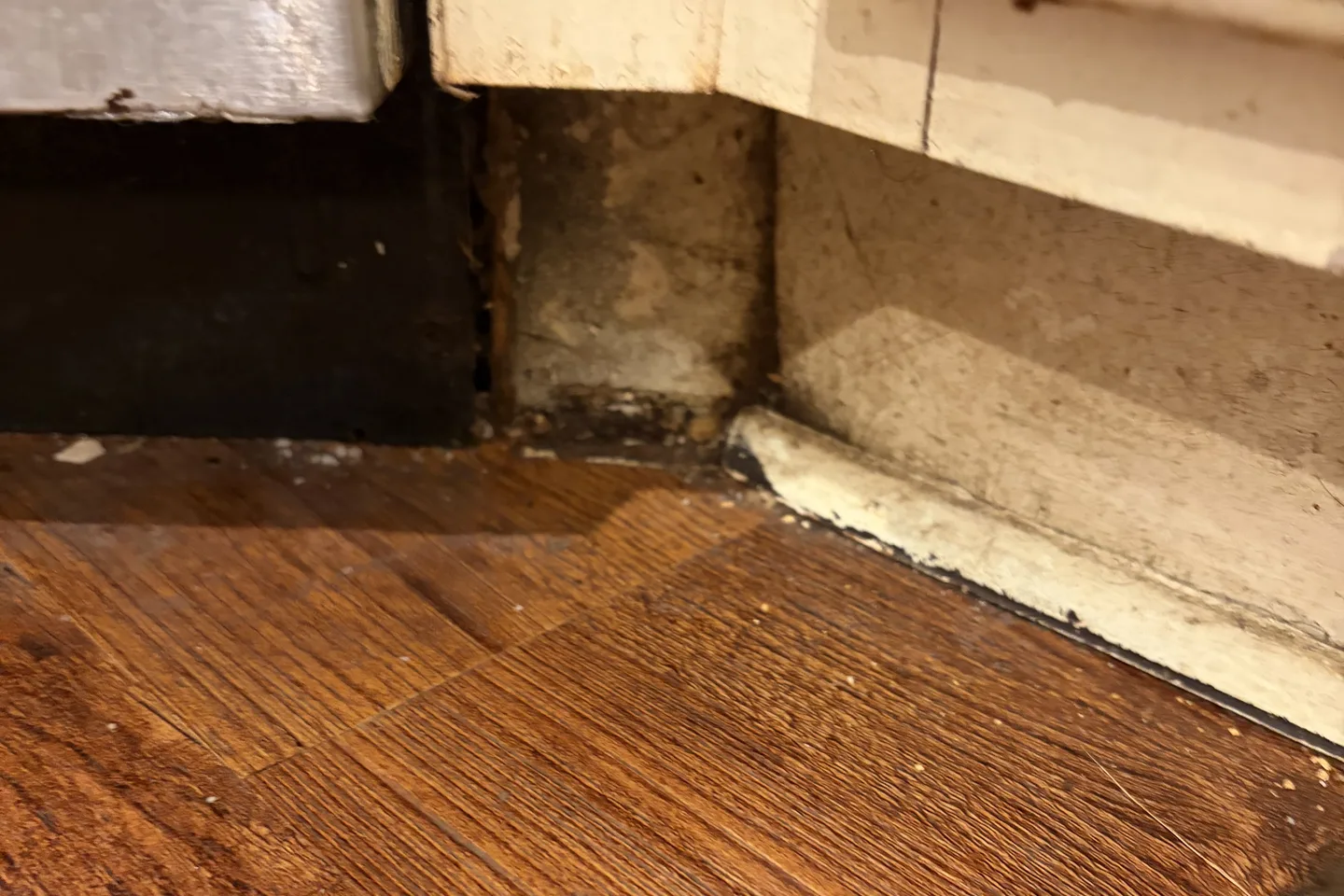
Mold Found Behind a Kitchen Toe-Kick From a Dishwasher Leak
A Frisco homeowner requested a limited mold assessment because of a musty odor near the kitchen sink. No visible mold growth was observed on accessible surfaces inside the stained sink base cabinet. Immediately to the left of the sink, beside the dishwasher, a detached and deteriorated toe-kick was very wet and visibly discolored. An active dishwasher leak was observed, and a surface swab confirmed fungal growth on the toe-kick, including Heavy Aspergillus/Penicillium-like structures and Moderate Cladosporium. Concealed areas behind and beneath the dishwasher, beneath cabinetry and at the subfloor were not opened or evaluated.
View Case Study →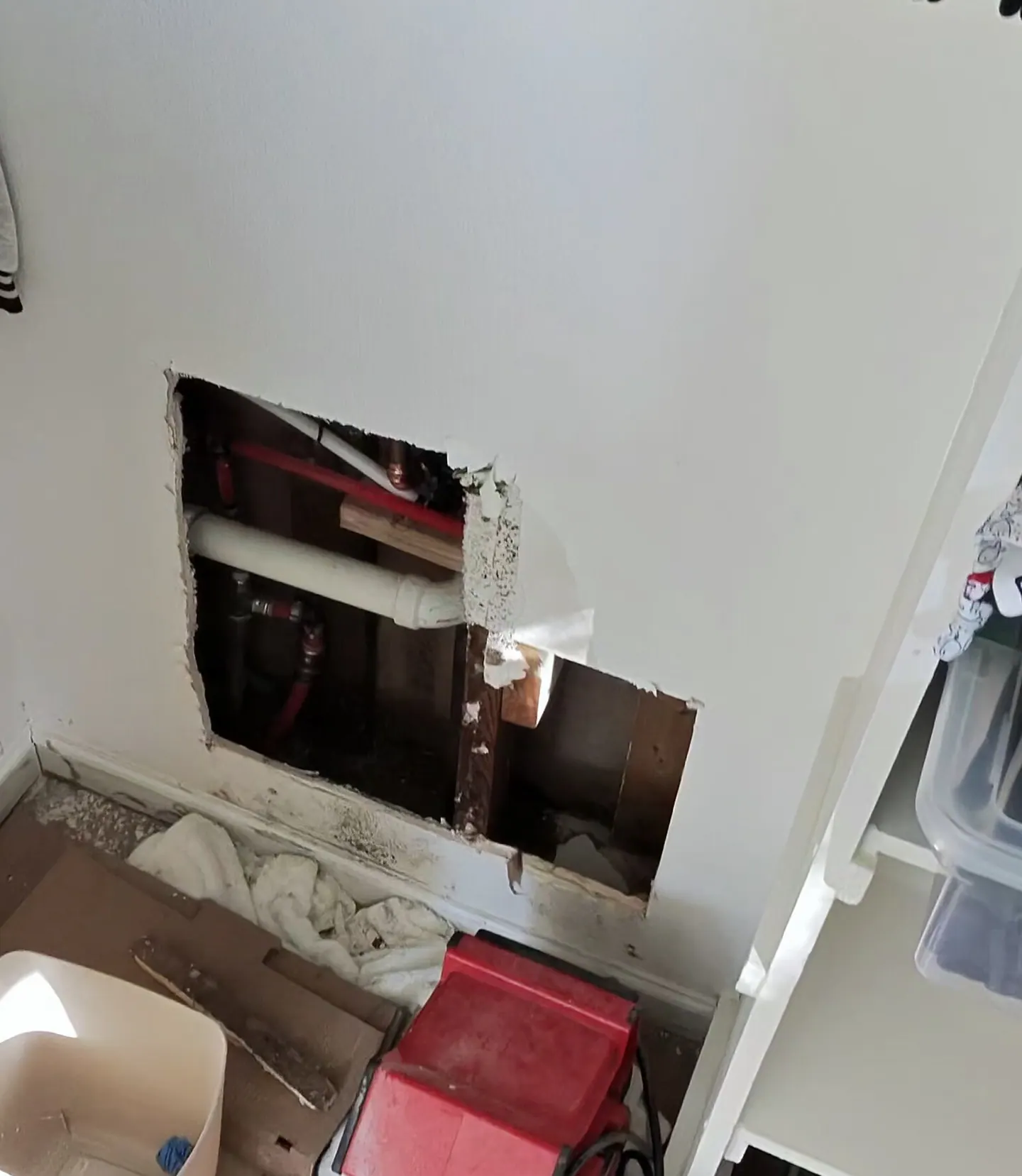
Mold Found Inside a Wall After a Plumbing Leak in Farmers Branch
A Farmers Branch homeowner requested a limited mold assessment after a reported plumbing leak affected a wall shared by a guest bathroom and two closets. The leak had reportedly been repaired, but existing repair openings exposed stained wallboard and framing. A swab through the guest bedroom closet opening supported fungal growth on sampled material. Separate ceiling and former exterior-wall concerns had different, more limited findings.
View Case Study →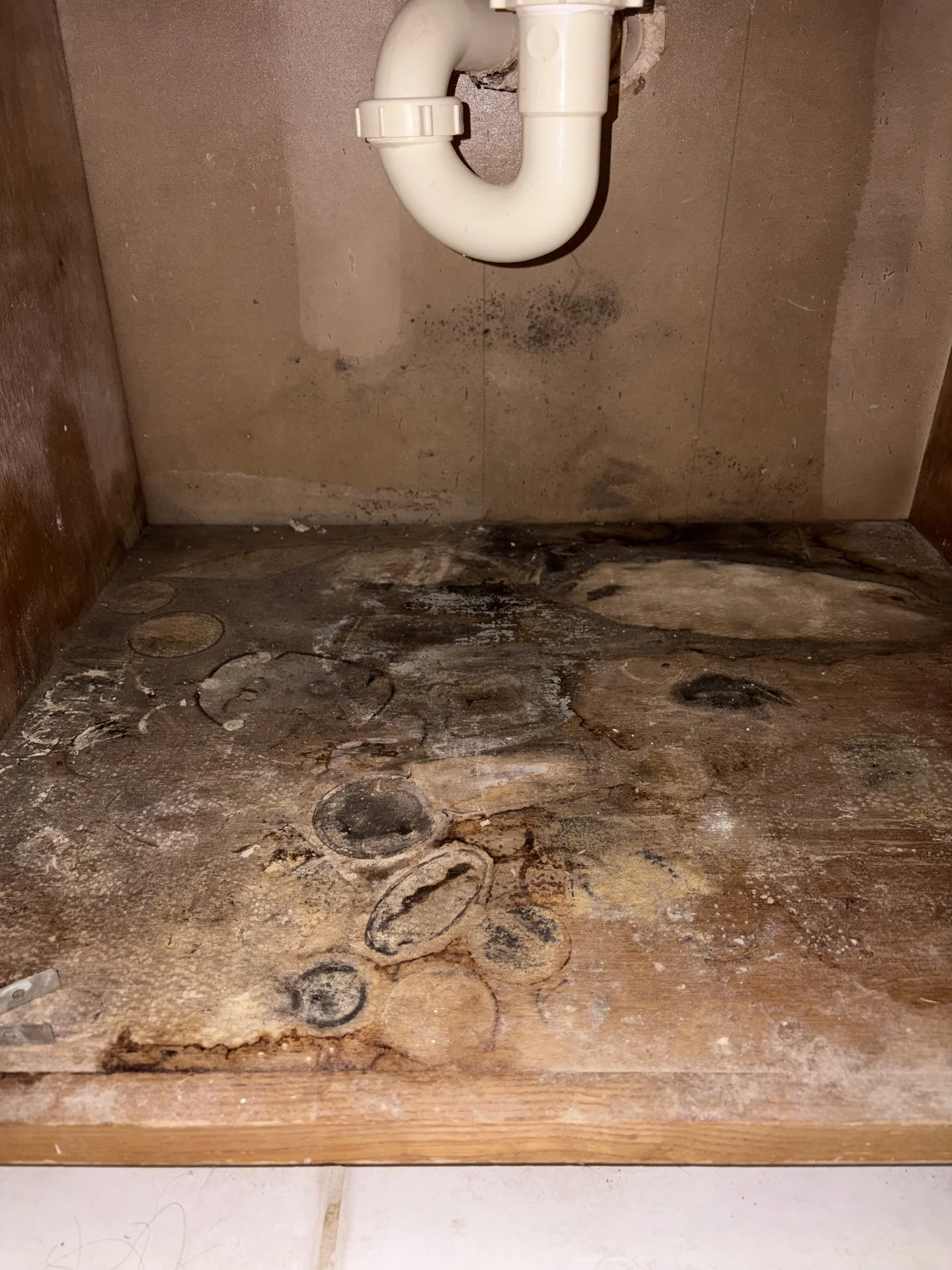
Hidden Mold Found Under a Bathroom Sink Cabinet
A homeowner reported a bathroom sink leak that occurred only during sink use. Although the sink had reportedly not been used for several days, the cabinet floor, toe kick and base were still visibly wet. The floor showed staining, swelling, delamination and suspected mold-like discoloration. A cabinet-floor swab returned Heavy Chaetomium and Heavy hyphal fragments. Through a small drilled access hole, limited borescope viewing showed suspected growth beneath the cabinet floor, and a 10-liter cavity air sample contained more than 76,000 Aspergillus/Penicillium-like spores/m³ and more than 80,000 total fungal structures/m³. Remediation of the affected cabinet and related materials appeared warranted; the specific plumbing failure and concealed extent remained undetermined.
View Case Study →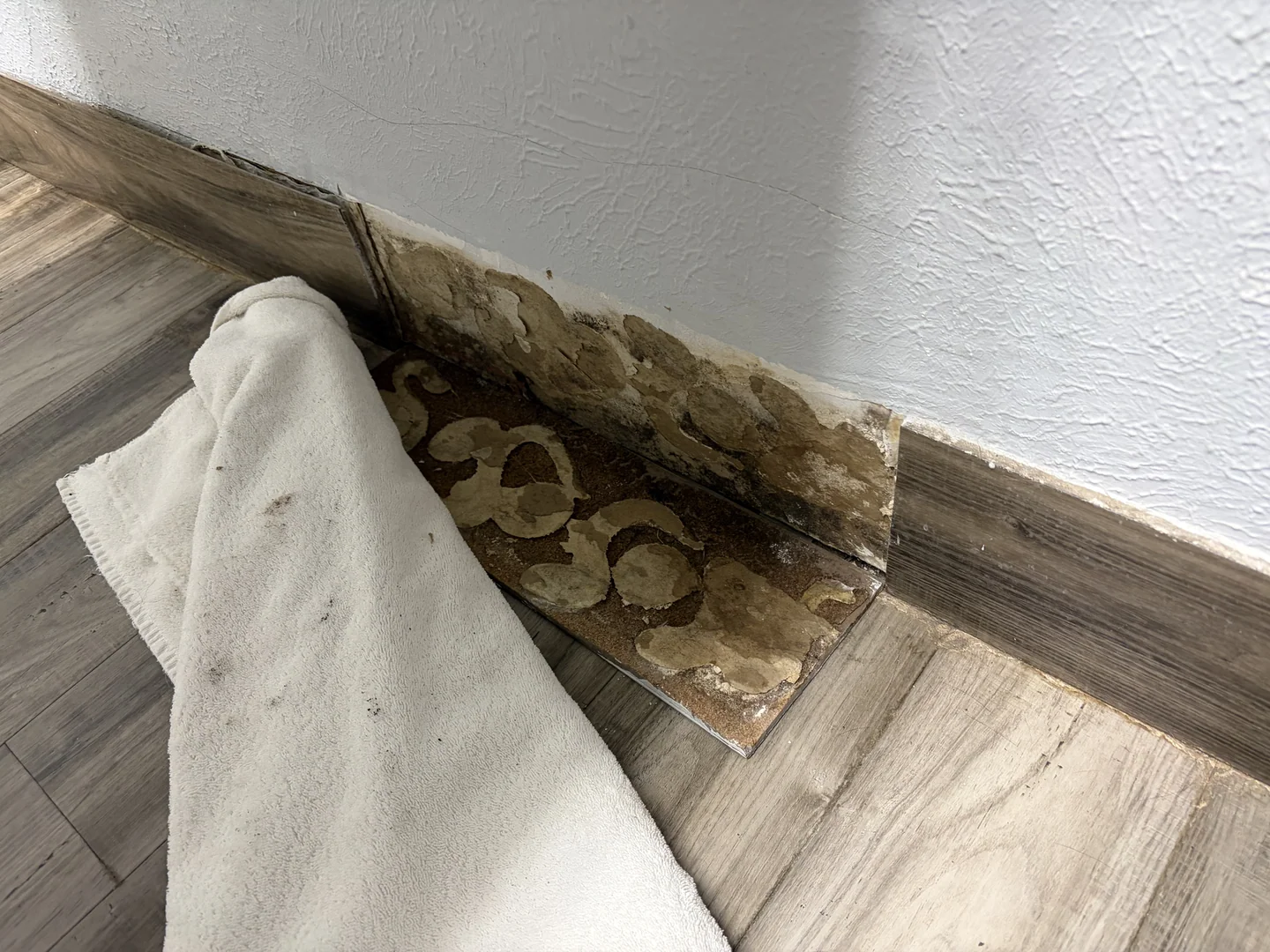
Mold Found After a Repaired Plumbing Leak in a Grand Prairie Commercial Building
A commercial building owner requested an independent assessment after a plumbing leak in a tenant-occupied veterinary facility had been repaired. The wall had reportedly remained open for several weeks to dry. Staff reported intermittent floor saturation over approximately two years, stopping after the repair. No active water or significant comparative moisture anomaly was observed at inspection, and accessible closet surfaces showed no visible mold. In Exam Room 1, previously detached trim exposed stained drywall that tested Heavy for Chaetomium, Aspergillus/Penicillium-like structures and hyphal fragments. A sample from the shared wall cavity supported concern that fungal growth may also be present within the concealed assembly; its extent and conditions beneath the flooring were not determined.
View Case Study →Hidden Mold Found Inside Wall Cavities in a Dallas Home
A Dallas homeowner requested a limited assessment after concerns about possible concealed mold and prior water-damage conditions. Occupied-room air samples were below the outdoor reference, while two concealed wall cavities had substantially different findings. One cavity showed moisture abnormalities, deteriorated finishes and apparent growth by borescope; a second cavity returned more than 55,000 total fungal structures per cubic meter when re-sampled after its first sample was occluded. An upstairs storage area also showed moisture and apparent growth.
View Case Study →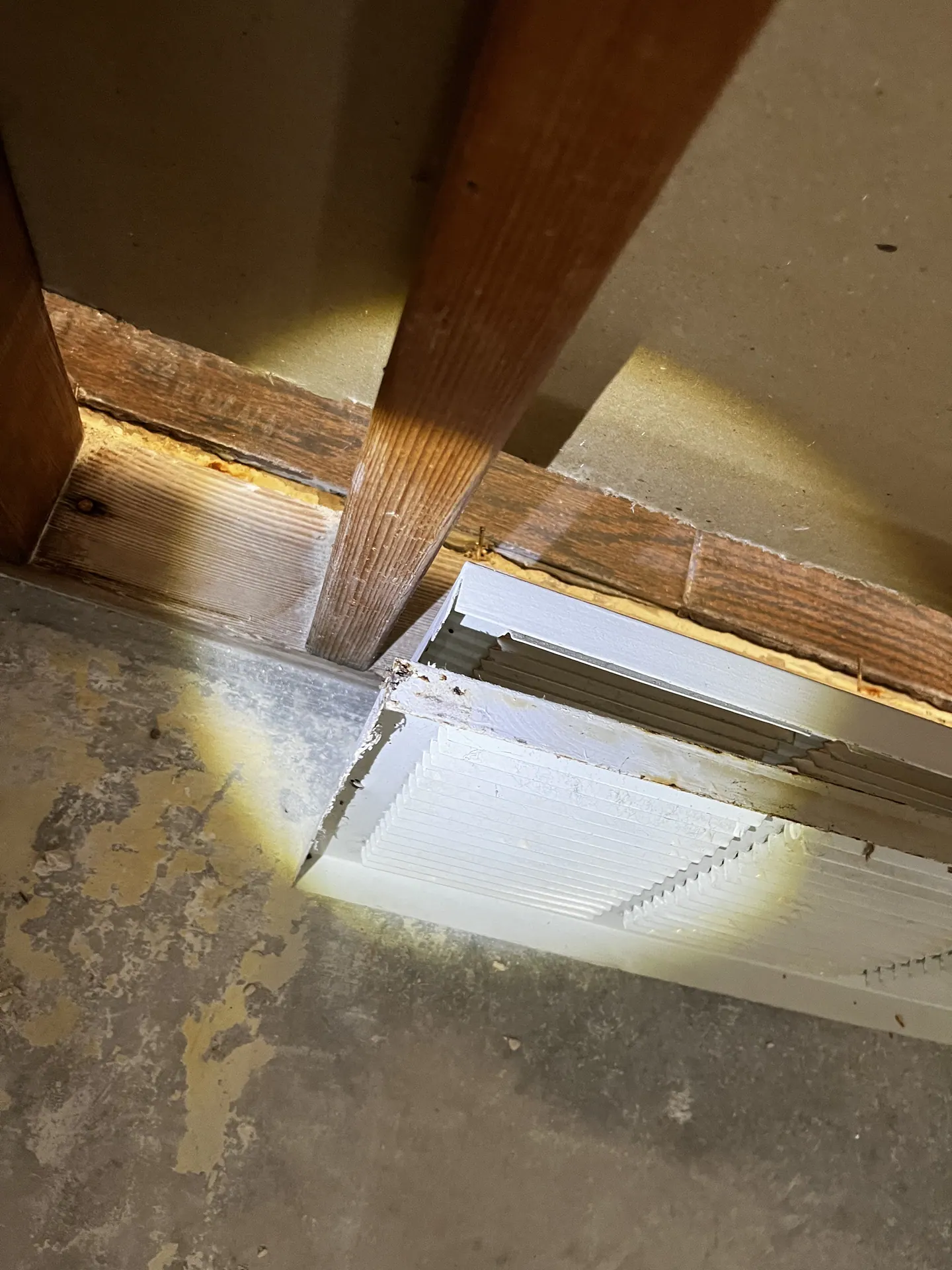
Mold Found After an AC Condensate Drain Overflow in a Fort Worth Home
A reported HVAC condensate-drain backup flooded the HVAC closet and adjoining rooms of a Fort Worth attached duplex residence while the homeowner was away. A restoration contractor had already made flood cuts and removed portions of flooring before the mold assessment. Six surface samples documented different findings across the affected areas: Heavy Stachybotrys at the HVAC-closet concrete-floor surface, Heavy Chaetomium at a water-affected bedroom wall, and Heavy Cladosporium with Heavy hyphal fragments on a bedroom supply register. No air samples were collected.
View Case Study →