
- Location
- Fort Worth, Texas
- Property type
- Residential; one half of an attached duplex, slab-on-grade
- Inspection type
- Limited mold assessment
- Primary concern
- Reported HVAC condensate-drain overflow and suspected mold after water-loss restoration work
- Inspection
- August 2026
- Published
- September 2026
The Situation
The homeowner reported that an HVAC condensate drain had backed up and overflowed while the property was unoccupied. Water discharged from the HVAC closet into the adjoining hallway and multiple rooms on one side of the attached residence.
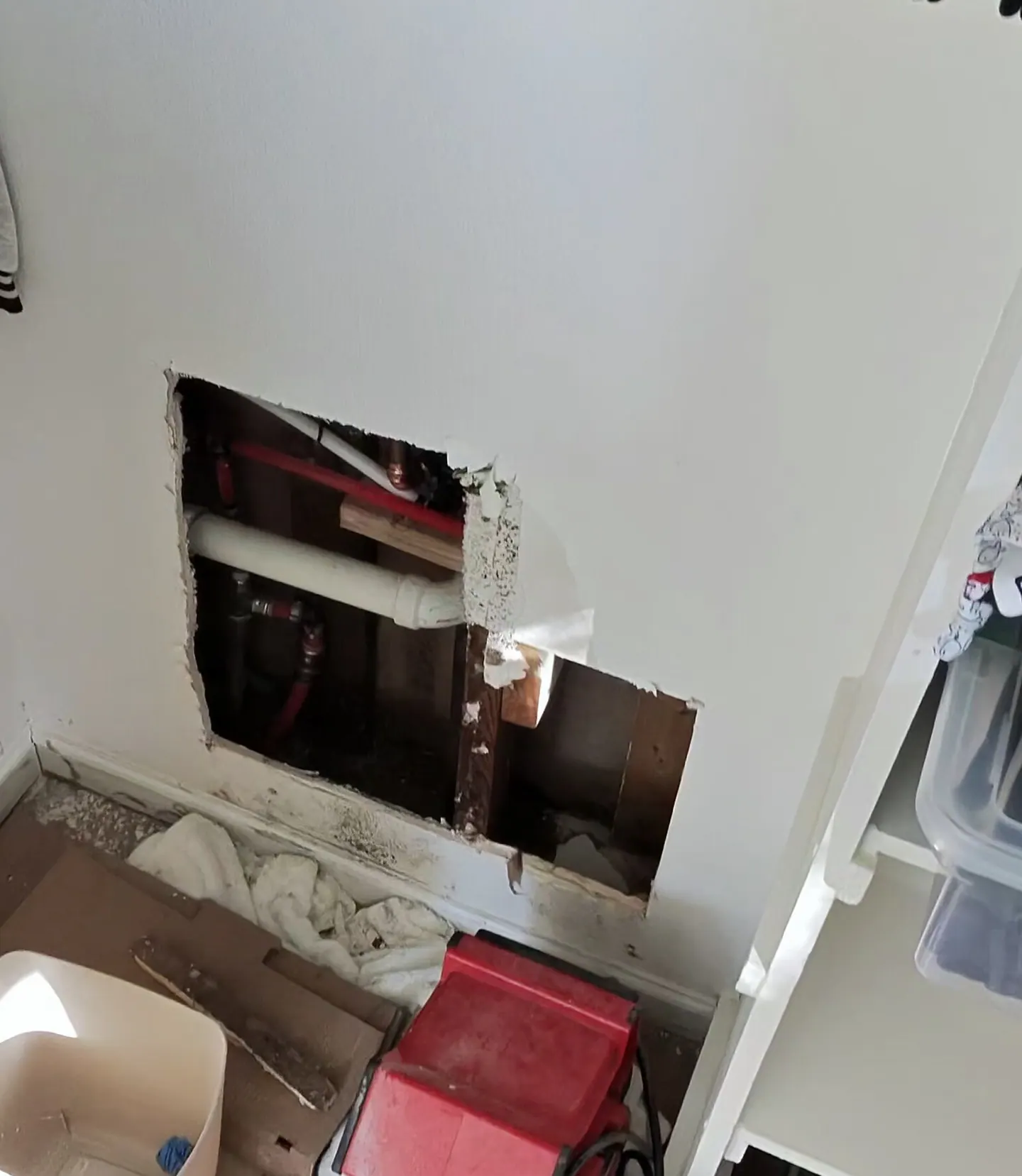
Before the mold assessment, a restoration contractor had performed flood cuts, removed lower portions of affected wall assemblies, and removed portions of flooring. That earlier work was water-loss restoration, not mold remediation conducted under a mold-remediation protocol.
The assessor examined accessible surfaces already exposed by that work and collected six targeted surface swabs. The assessment did not involve air sampling.
What Was Inspected
- The restoration contractor, not Mold Testing Dallas, made the flood cuts and removed flooring and wall portions before the assessment. The assessor did not demolish, enlarge openings, remove building materials, or perform mold remediation.
- The concrete floor in the HVAC-closet air-intake area was sampled through an existing opening at the base of the closet; no material was removed to collect it. The floor directly beneath the installed platform and the platform itself were not observed or sampled.
- Duct interiors beyond the supply-register openings were not evaluated. No air samples were collected, so airborne concentrations and whole-house air quality were not measured.
What We Observed
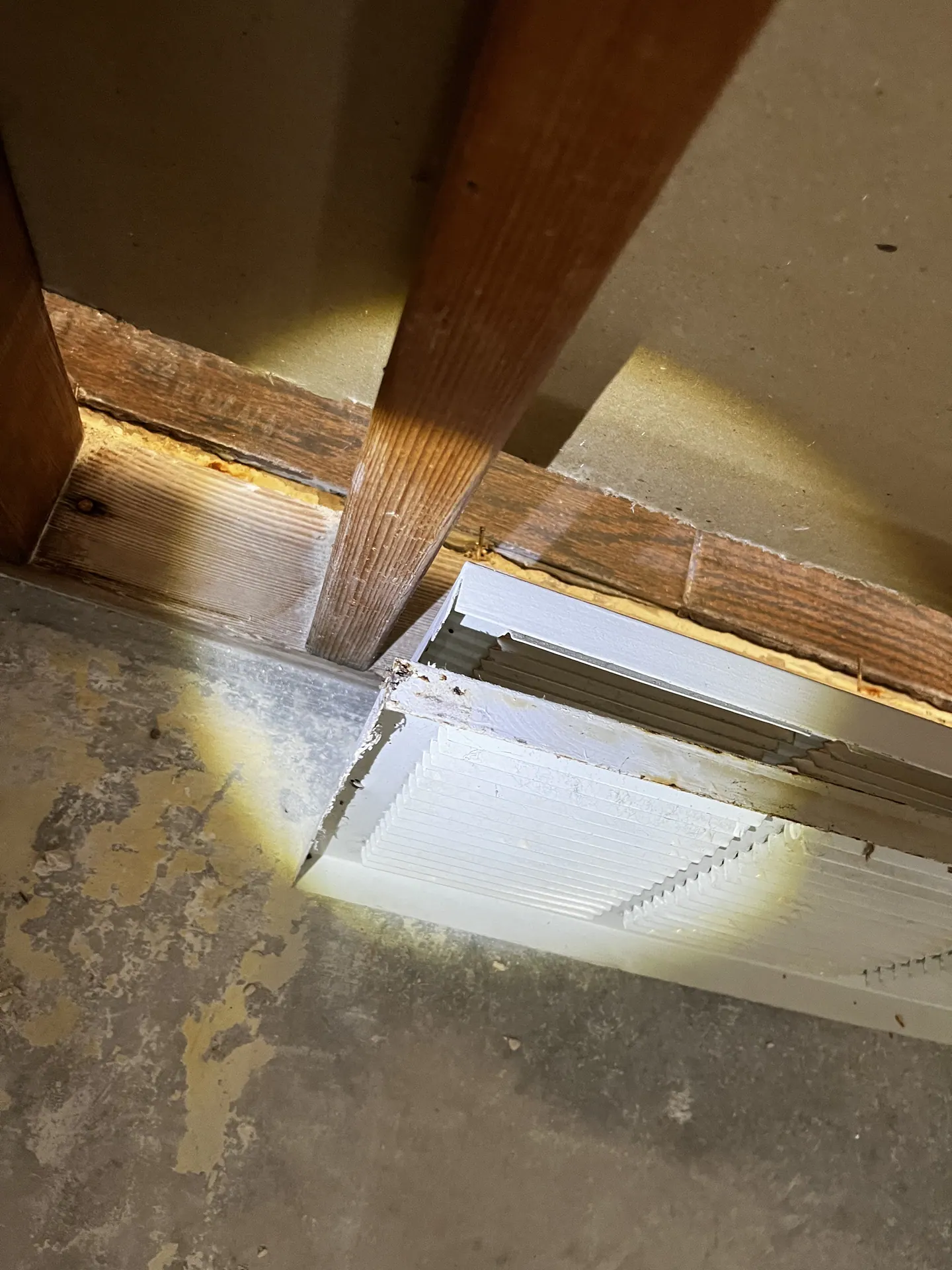
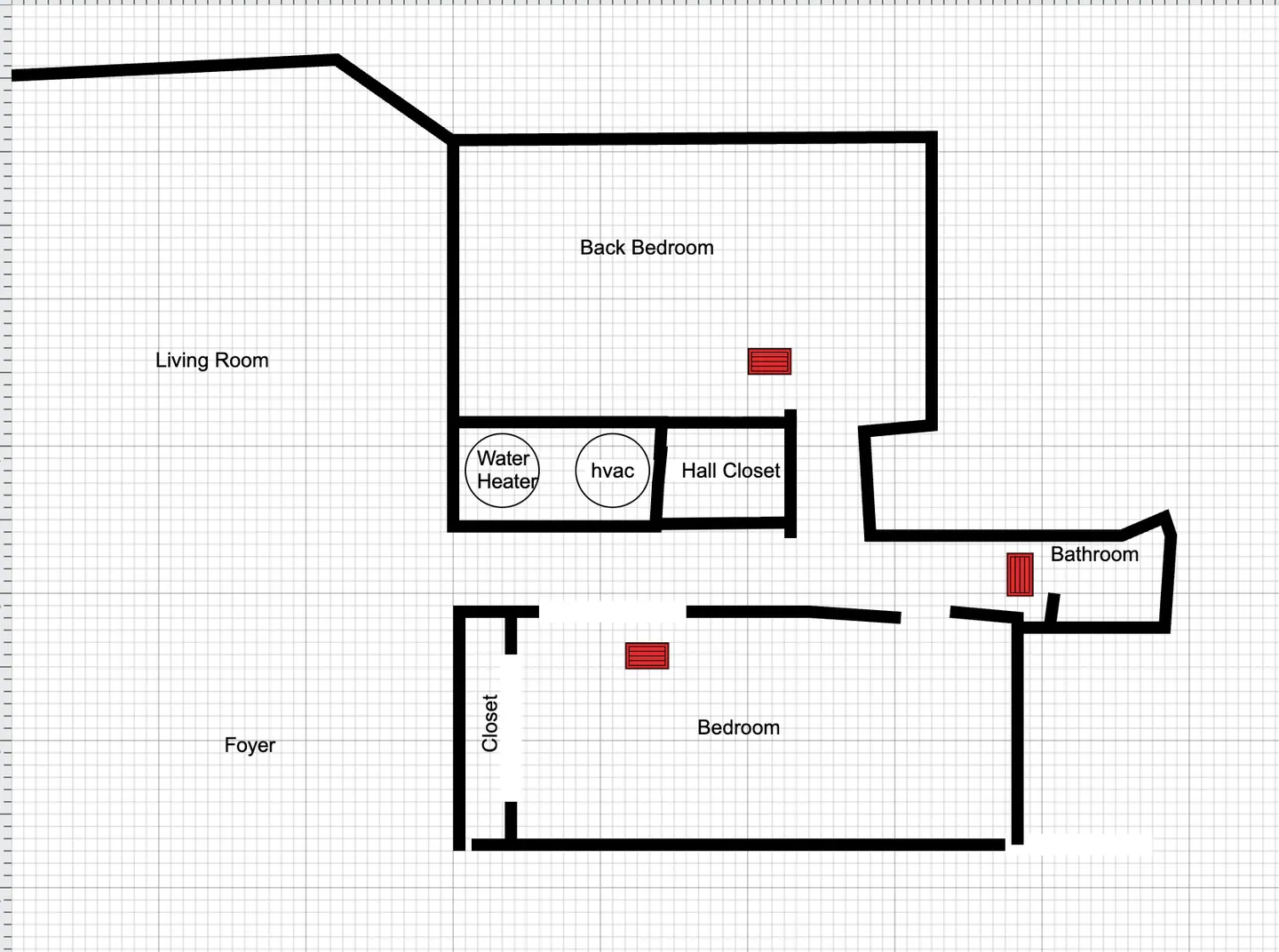
The HVAC closet contained an air handler and electric water heater on a raised wood platform above a concrete slab, with condensate piping and a floor drain at slab level. Staining and discoloration were visible on the concrete beneath and around the platform and on an exposed platform-decking edge. The sample came from the accessible concrete floor in the air-intake area, not from the platform.
The front bedroom and closet had prior flood cuts along the base of the walls. The homeowner reported substantial wetting there and separately reported water entering near the exterior wall shared with the adjoining duplex unit's porch. That reported wall-entry concern was not established as the original condensate-water pathway.
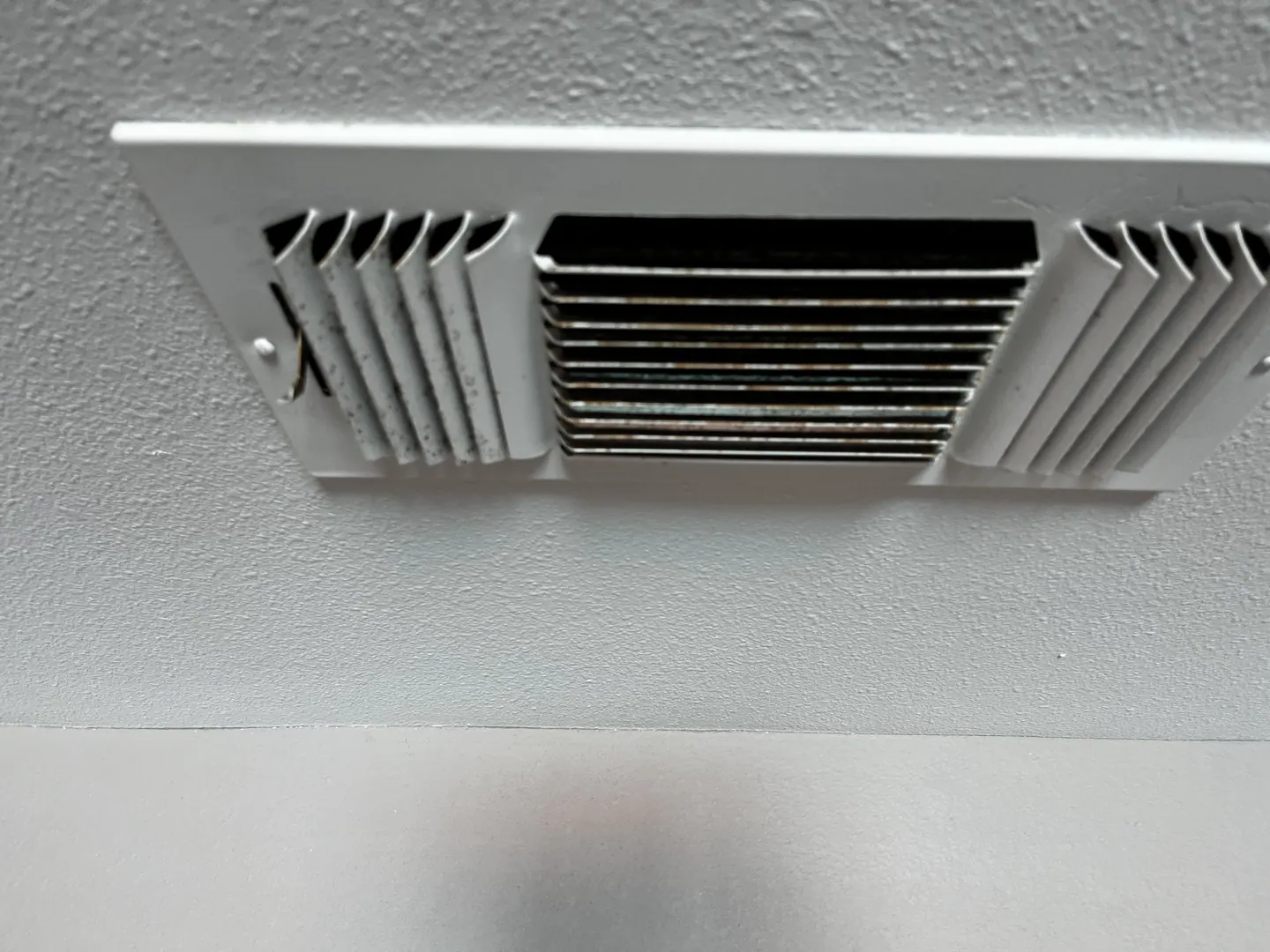
Dark speckled deposits appeared on supply-register faces in heavily water-affected rooms. The back-bedroom register was sampled. Comparable deposits did not visibly extend into the duct at register openings; registers in rooms without heavy water did not show the same condition.
Stachybotrys Was Found at the HVAC Closet Floor
The HVAC closet was the reported origin of the overflow. Its raised wood equipment platform stood above the slab. The sample was taken from the accessible concrete-floor surface in the air-intake area beneath and adjacent to that platform, through an opening already present at the closet base.
That sample returned Heavy Stachybotrys and Minor Chaetomium, Aspergillus/Penicillium-like structures, and hyphal fragments. The assessment interpreted the Heavy result as consistent with fungal growth at the sampled surface. The directly concealed floor beneath the installed equipment/platform was not observed, and the platform itself was not sampled.
Chaetomium Was Confirmed at a Heavily Water-Affected Bedroom Wall
The front-bedroom exterior wall shared a boundary with the neighboring duplex unit's porch. An accessible surface inside its preexisting flood-cut opening returned Heavy Chaetomium, Moderate hyphal fragments, and Minor Aspergillus/Penicillium-like structures. Given the reported heavy wetting, the assessment interpreted these findings as consistent with fungal growth, not ordinary settled dust.
The homeowner also reported seeing water near that wall between the foundation and brick veneer. That was a separate reported water-entry concern, not a definitively established route for the condensate overflow. The assessment recommended evaluating conditions on the adjoining side of the shared wall.
Mold Was Also Confirmed on a Bedroom Supply Register
Dark deposits were observed on metal supply-register faces in heavily water-affected rooms. A swab from the back-bedroom register returned Heavy Cladosporium and Heavy hyphal fragments, plus Minor non-specified spore, Epicoccum, and Aspergillus/Penicillium-like structures. The Heavy results supported fungal growth on that sampled register face.
Comparable deposits were not seen extending upward into the duct at the register openings. The assessor interpreted the register condition as consistent with localized condensation-related growth in the water-affected rooms, rather than confirmed growth originating inside the ducts. The duct system beyond the openings was not evaluated.
Moisture / Building Conditions
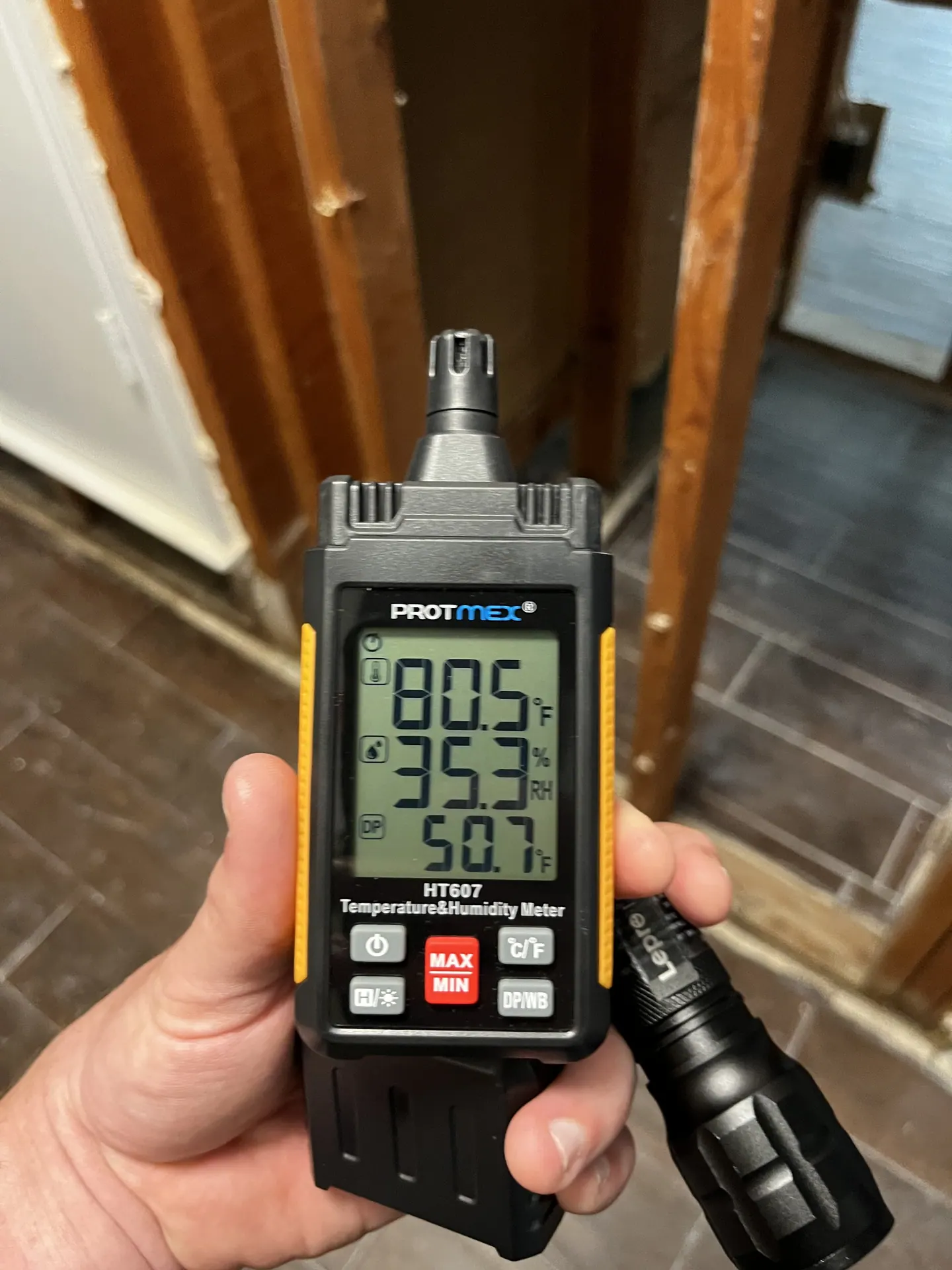
At inspection, indoor air measured 80.5°F, 35.3% relative humidity, and a 50.7°F dew point. Relative humidity was not elevated at that moment; the reading cannot establish what moisture conditions were during the earlier water loss.
Sampling Performed
- Surface swab — Concrete-floor air-intake area beneath and beside the HVAC equipment platform: Collected through an existing closet opening, without material removal.
- Surface swab — Front-bedroom exterior wall inside an existing flood-cut opening
- Surface swab — Back-bedroom supply-register face: Duct interior was not swabbed.
- Surface swab — Hall closet
- Surface swab — Back-bedroom/HVAC-closet shared wall
- Surface swab — Blinds
Laboratory Findings
| Sample | Finding | Reported result | Context |
|---|---|---|---|
| HVAC-closet concrete-floor surface | Stachybotrys | Heavy | |
| HVAC-closet concrete-floor surface | Chaetomium | Minor | |
| HVAC-closet concrete-floor surface | Aspergillus/Penicillium-like structures | Minor | |
| HVAC-closet concrete-floor surface | Hyphal fragments | Minor | |
| Front-bedroom exterior wall | Chaetomium | Heavy | |
| Front-bedroom exterior wall | Hyphal fragments | Moderate | |
| Front-bedroom exterior wall | Aspergillus/Penicillium-like structures | Minor | |
| Back-bedroom supply-register face | Cladosporium | Heavy | |
| Back-bedroom supply-register face | Hyphal fragments | Heavy | |
| Back-bedroom supply-register face | Non-specified spore | Minor | |
| Back-bedroom supply-register face | Epicoccum | Minor | |
| Back-bedroom supply-register face | Aspergillus/Penicillium-like structures | Minor | |
| Hall closet | Non-specified spore | Minor | |
| Hall closet | Aspergillus/Penicillium-like structures | Minor | |
| Back-bedroom/HVAC-closet shared wall | Pithomyces | Minor | |
| Back-bedroom/HVAC-closet shared wall | Myxomycetes/Periconia/Smut/Rust | Minor | |
| Back-bedroom/HVAC-closet shared wall | Alternaria | Minor | |
| Back-bedroom/HVAC-closet shared wall | Aspergillus/Penicillium-like structures | Minor | |
| Back-bedroom/HVAC-closet shared wall | Cladosporium | Minor | |
| Back-bedroom/HVAC-closet shared wall | Hyphal fragments | Minor | |
| Blinds | Multiple fungal structures | Minor only |
Understanding the Laboratory Rating
Heavy is the laboratory's highest direct-examination category. A Heavy finding combined with site conditions supported fungal growth at the HVAC-closet floor surface, the front-bedroom wall, and the sampled register. These are surface findings, not airborne measurements or health-risk ratings.
Minor is the lowest nonzero category. Minor-only findings may reflect ordinary settled dust and were not treated as proof of active mold growth at the hall closet, shared wall, or blinds.
How Could Stachybotrys Be Found on Concrete?
Concrete is not cellulose. Stachybotrys is primarily associated with wet cellulose-containing organic material, not growth on bare concrete itself. Organic material accumulated on a slab surface—such as dust, debris, paper facing, adhesive, or wood fragments—could support a finding at the concrete-floor surface.
The sampled surface had Heavy Stachybotrys; the supporting organic material was not separately identified. This result does not confirm contamination beneath the entire platform or on the platform itself. The concealed area warranted evaluation within the separately prepared remediation scope.
Not Every Sample Showed Active Mold Growth
The hall-closet swab returned only Minor non-specified spore and Aspergillus/Penicillium-like findings. The back-bedroom/HVAC-closet shared-wall sample returned only Minor Pithomyces, Myxomycetes/Periconia/Smut/Rust, Alternaria, Aspergillus/Penicillium-like, Cladosporium, and hyphal fragments. The blinds sample had multiple fungal structures at Minor level only.
Minor was the lab's lowest nonzero direct-examination category. Such findings can occur in ordinary settled dust and did not, by themselves, establish active fungal growth at these three locations.
What the Findings Suggested
The assessment found different surface conditions within the same water-affected property. Heavy Stachybotrys at the accessible HVAC-closet floor, Heavy Chaetomium at a front-bedroom wall, and Heavy Cladosporium with Heavy hyphal fragments on the sampled back-bedroom register supported fungal growth at those specific sampled locations.
The closet floor directly beneath the installed platform remained concealed, and the equipment platform itself was not sampled. The register result supported growth on the register face, not evidence of contamination inside the ducts.
Existing water-loss demolition exposed surfaces for inspection but did not constitute mold remediation. An appropriately licensed consultant subsequently prepared a protocol for professional corrective work.
Water-Damage Demolition Is Not the Same as Mold Remediation
The restoration contractor had already made flood cuts and removed some water-affected materials. That work was not mold remediation under a mold-remediation protocol. The later mold assessment found fungal growth on several accessible surfaces and documented which areas warranted further professional attention. These facts do not establish that the earlier contractor acted improperly.
A licensed Texas Mold Assessment Consultant subsequently prepared a formal remediation protocol. Professional remediation was determined to be warranted; the protocol addressed affected materials and concealed areas requiring evaluation. This public case study is not a remediation procedure.
Recommendations
- Confirm that the condensate drain has been cleared and is operating properly, and correct any condition contributing to the original backup.
- Perform corrective work under the licensed Texas Mold Assessment Consultant's formal remediation protocol, using an appropriately licensed Texas mold-remediation contractor. Stop uncontained demolition if additional suspected mold growth is exposed.
- Have a qualified professional evaluate the HVAC condensate drain, pan, equipment platform, supply registers, and duct system; the present assessment did not establish duct contamination.
- Maintain indoor relative humidity below 60% and evaluate conditions on the adjoining side of the shared exterior wall in this attached duplex.
What Homeowners Can Learn From This Case
The same water loss can produce different surface findings in different places. This assessment found Heavy Stachybotrys at one sampled floor area, Heavy Chaetomium at another wall, Heavy Cladosporium on a register, and only Minor findings at three other sampling locations.
Post-water-loss assessment can document the source reported by the owner, inspect areas already opened during restoration, evaluate framing and slab surfaces, examine HVAC-adjacent materials, and use targeted sampling without assuming that every detected structure represents an active growth source.
Questions About This Case
Can an AC condensate drain overflow cause mold?
A drain backup can wet floors, walls, framing, and adjacent materials. In this Fort Worth case, surface samples confirmed growth at multiple locations after the reported condensate-drain overflow.
Can mold still be present after flood cuts are made?
Yes. Earlier flood cuts exposed materials, but they were not mold remediation. This assessment collected surface samples after those cuts and found growth at several accessible locations.
Can Stachybotrys be found under an HVAC unit?
Heavy Stachybotrys was detected at an accessible concrete-floor surface beneath and beside this equipment platform. The floor directly beneath the installed platform and the platform itself were not sampled; organic material on the slab surface may have supported the finding.
Does Stachybotrys grow directly on concrete?
Concrete itself is not cellulose. A result from a concrete-floor surface may reflect growth supported by organic dust, debris, adhesive, paper, or wood fragments on that surface. The precise supporting material here was not identified.
Can mold grow on an HVAC vent without mold being inside the ducts?
Yes. Heavy Cladosporium and Heavy hyphal fragments were found on the sampled back-bedroom register face. Comparable deposits were not observed extending into the duct at the opening; the rest of the duct system was not evaluated.
Does every Minor mold result mean remediation is needed?
No. Minor is the laboratory's lowest nonzero category, and Minor findings alone can occur in ordinary settled dust. Three sampled locations in this case had only Minor findings and were not considered proof of active growth by themselves.
Can mold remain after the original water source is fixed?
Yes. Stopping the water source does not establish that previously wet materials are free of fungal growth. This case documented growth after the initial water-loss response.
Related Services
Had an AC Drain Backup or Water Loss?
Even after extraction, demolition, or flood cuts, water-affected materials may still warrant evaluation if staining, suspected mold, or unresolved concerns remain.
Schedule a Mold InspectionInspection performed by Ethan Wright, TDLR Licensed Mold Assessment Technician (MAT #1589).
Related Real Inspection Cases
Compare a plumbing-leak wall assessment and an irrigation-related water-intrusion case first. In a separate HVAC case, growth was limited to the exterior of condensate piping without a reported multiroom overflow; another found visible growth inside one damaged duct branch.
Mold Found Inside a Wall After a Plumbing Leak in Farmers Branch
A Farmers Branch homeowner requested a limited mold assessment after a reported plumbing leak affected a wall shared by a guest bathroom and two closets. The leak had reportedly been repaired, but existing repair openings exposed stained wallboard and framing. A swab through the guest bedroom closet opening supported fungal growth on sampled material. Separate ceiling and former exterior-wall concerns had different, more limited findings.
View Case Study →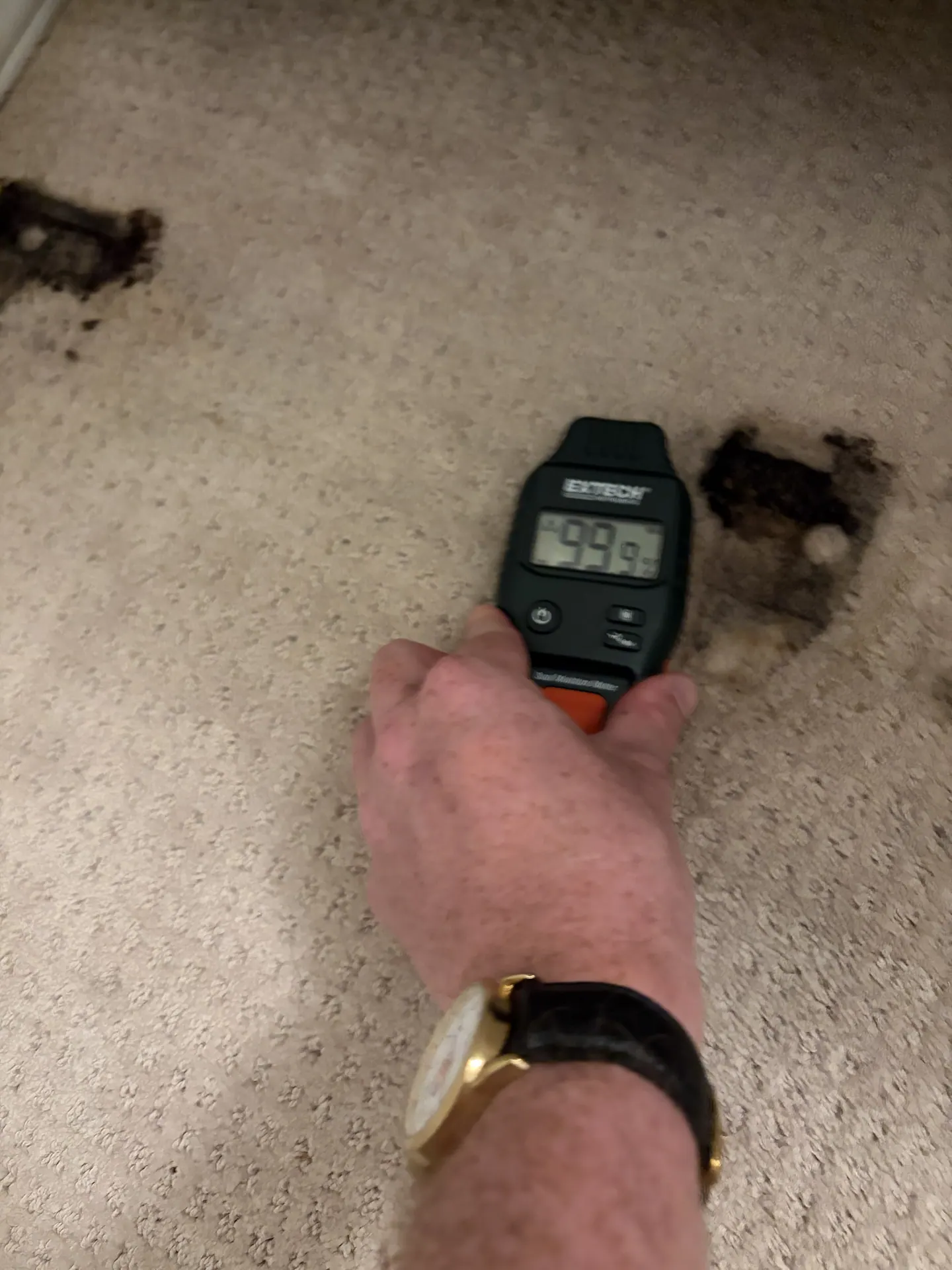
Mold and Water Intrusion From Landscape Irrigation in a Dallas Bedroom
A Dallas homeowner noticed visible growth on a guest-bedroom nightstand foot. A limited assessment found two wet carpet and lower-wall zones along the exterior wall, aligned horizontally with two exterior areas showing algae-like growth. A swab of one stained wet carpet area supported fungal growth, including Heavy Chaetomium and Heavy hyphal fragments. Landscape irrigation was identified as the probable recurring moisture source; the precise route of water entry was not confirmed.
View Case Study →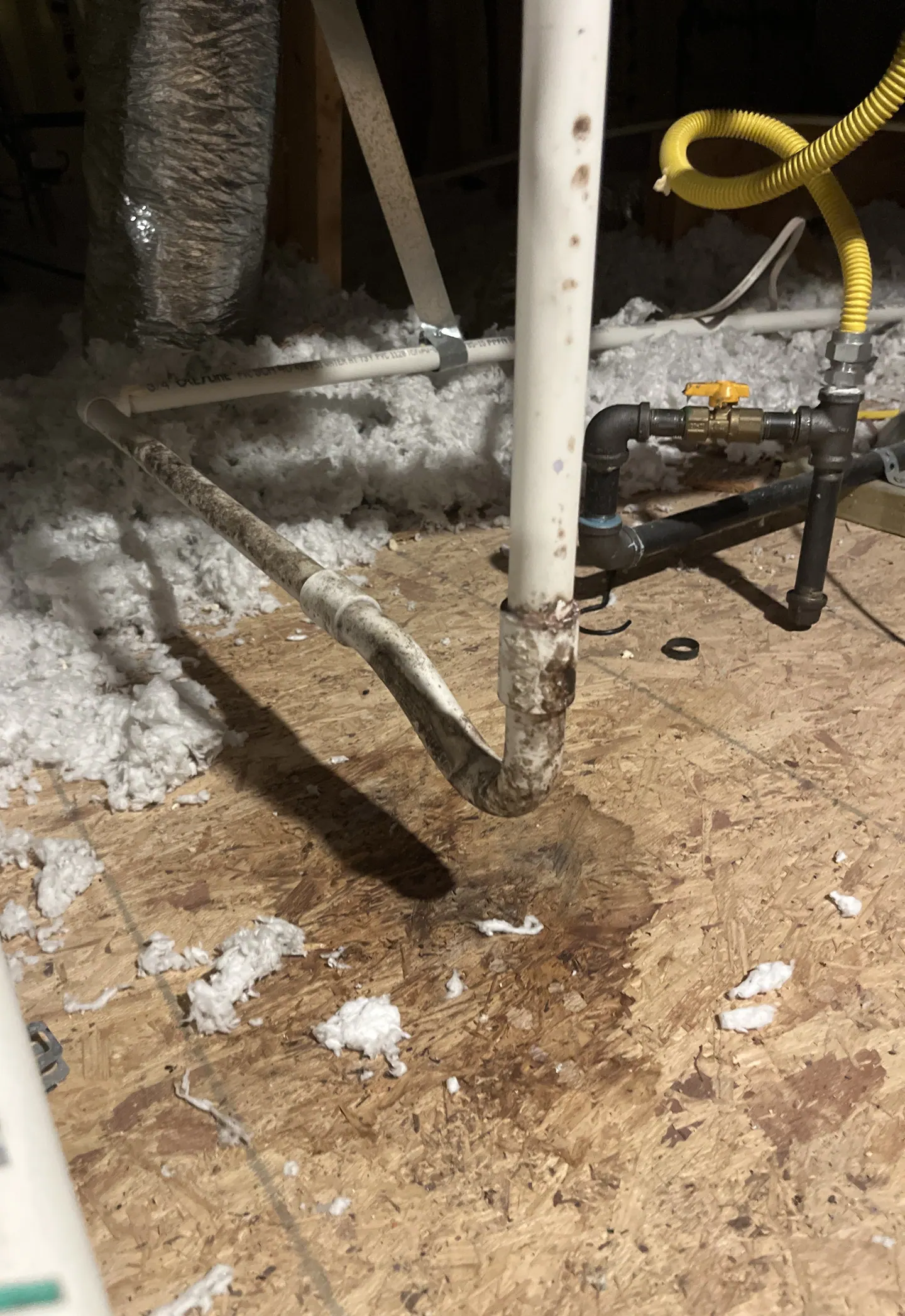
Mold on an AC Condensate Drain Line in a Dallas Attic
A Dallas homeowner requested an independent assessment after an HVAC technician noticed suspected growth on attic condensate piping. A surface swab supported fungal growth on the pipe exterior; no visible mold growth was observed inside accessible portions of the air handler or connected ductwork.
View Case Study →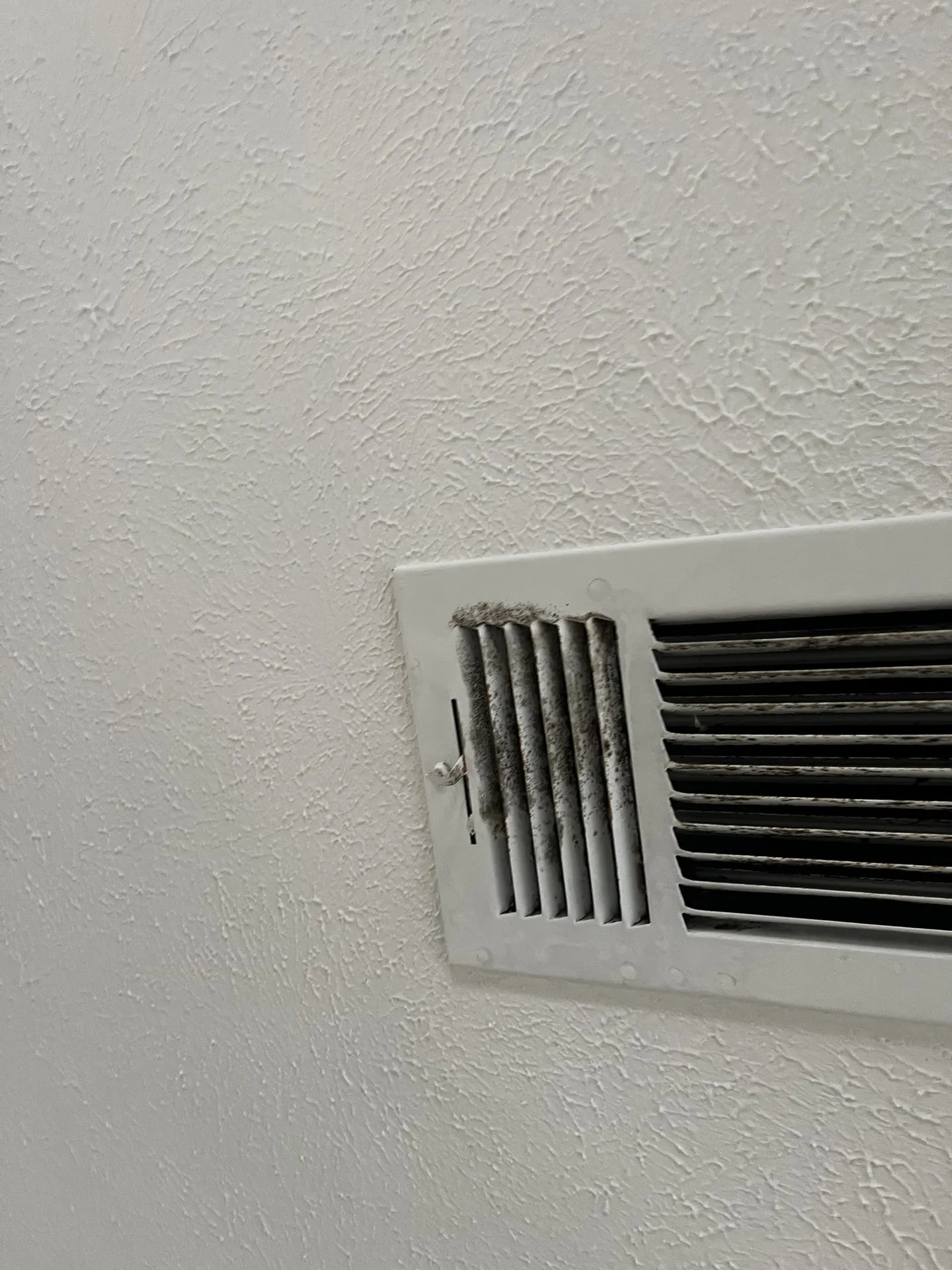
Mold Found Inside One HVAC Duct Branch in a Dallas Home
A Dallas homeowner requested an independent assessment after an HVAC contractor saw material inside supply ductwork that might have been microbial growth or dirt. Two playroom supply grills and accessible interior surfaces behind them showed visible growth. Both grills shared one duct branch with damaged jacket and insulation; the accessible air handler and other inspected runs showed no comparable growth. A swab from the left playroom grill returned Heavy Cladosporium, while the playroom air sample did not show amplification relative to an outdoor comparison at the sampled time.
View Case Study →